This isn’t a regular review post. It is rather an after-the-fact wrap-up post. I read books 1 through 7 in this series. I wrote reviews for some of the books on Goodreads as I read them, but others I did not. I never posted any here on the blog. But I am putting together an author’s read list and want to be as complete as possible. So, I’m bringing the reviews I wrote together here on the blog. 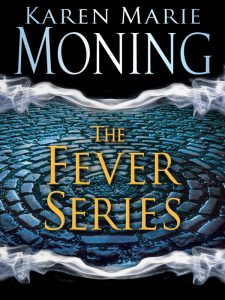
When MacKayla’s sister was murdered, she left a single clue to her death, a cryptic message on Mac’s cell phone. Journeying to Ireland in search of answers, Mac is soon faced with an even greater challenge: staying alive long enough to master a power she had no idea she possessed – a gift that allows her to see beyond the world of man, into the dangerous realm of the Fae.
As Mac delves deeper into the mystery of her sister’s death, her every move is shadowed by the dark, mysterious Jericho…while at the same time, the ruthless V’lane – an alpha Fae who makes sex an addiction for human women – closes in on her. As the boundary between worlds begins to crumble, Mac’s true mission becomes clear: to find the elusive Sinsar Dubh before someone else claims the all-powerful Dark Book – because whoever gets to it first holds nothing less than complete control both worlds in their hands.
Reviews:
DarkFever: A pretty middle-of-the-road, all-right read, marred by an extremely annoying heroine. I didn’t hate her. She wasn’t TSTL or anything, but she was Barbie. I often complain about the lack of diversity in UF/PNR heroines. And more than once, I’ve referred to a character as generically Barbie-like. I think this is the first such book that I’ve read that openly described the character that way, as Barbie. Not just as a slender, busty blond with a love of all things shiny, pink, and soft, but as “Barbie.”
The character is well aware of her appealing physical attributes, too. It felt a bit like seeing the most popular girl in school get to be the world-saving hero, too—just unfair, really. And I’m not just being judgemental, either. I could have handled all that if I didn’t find her bouncy personality (and often described step), pearl-draped, pink cashmere-clad Princess Pastel Rainbow voice so darned annoying.
On the other hand, the dark, dangerous maybe-hero Jericho was nearly enough to redeem the book for me. Too bad he spent most of the book being such a dick. By the end, I was starting to warm up to him. But it took a while.
In the end, I’m torn. My local library has all these books, so I have easy, free access to read them. I’m curious about what might happen, but I don’t know if I can really be bothered.
DreamFever: I’m not going to bother with a review of the fourth book in a series. What’s left to say, but do I like it more or less than the previous ones? But I will make a comment.
I was wary about reading this book, as it seemed to be predicated on the main character being raped and turning into a simpering sex slave. Which is dangerously close to reducing a woman’s value to nothing but sex, while allowing male characters to remain in control of themselves and her (and being worshipped for it). This is a trope that runs fairly close to the surface in a lot of romantic/erotic novels if cleverly disguised, and it turns me into a seething ball of indignation.
However, here, the ‘rapes’ (which were of the ‘I control your mind and make you want it’ as opposed to brute force type) were not graphic or detailed, the sexual savant only lasted a couple of chapters, and Mac was more inclined to demand sex than beg for it, allowing the whole scenario to not feel as sordid and disempowering as it could have. My point is that it wasn’t that bad.
Edit, as an additional, related thought: Why, why do soooo many of the strong female heroines on UF/PNR eventually have to have their power and control stripped away by rape at some point in a series? It’s almost beginning to feel like an expectation of the genre and that kind of disgusts me in general. I promise, it’s not the only way a woman can build strength of character and internal resilience. It’s not the only way to prove we really are strong survivors and it’s not the only plot device available to authors to provide a challenge to overcome. I really would like to see some variety in the genre and less insistence that rape is so common that all female characters have to encounter it eventually in order for readers to relate to her. It’s a fallacy, a falsehood, a myth. It’s disappointing.
Iced: A fun enough read, but not as good as the Fever books that it is a spin-off of. Dani is annoyingly oblivious for such a smart girl, and some of the ways she rationalises the obvious away is just plain stupid. New side characters are introduced but not fleshed out. (I suspect they are there for future books.) There is a lot more fantasy-like descriptions of stuff. Exploring the library, for example, felt very Harry Potter. The plot seems to drift a bit in the middle and the one major thing left over from the last book, that is hinted at throughout this one, is finally addressed on, literally, the last page and left as a cliffhanger. RUDE.
Mostly, however, my issues with the book stem from Dani being 14 years old. Like the previous books, this is a dark and, at times, sexual book, so why have we thrown a 14-year-old into the mix? I’m not one of the readers who believes that minors and sex can never cross in a plot. That wouldn’t reflect reality, and just because a minor has sex in a book doesn’t make it automatically pedophiliac. So, her actual age itself isn’t actually the problem. But if an author is going to place a minor (and not a 17 and 359-day-old minor, but an innocent, barely 14-year-old minor) in a sexually charged plot, it needs to be particularly dealt with. It wasn’t here. It was carefully dealt with, don’t get me wrong, but not in a way that worked for me, and it compromised the whole plot. Here’s why:
Dani’s spunky and bright. That’s great. And two dark, dangerous men are in love with her. OK. But one of the men is literally turning into an Unseelie prince (what is referred to as a death-by-sex fae), i.e., an elite member of the eviler of the two fae courts. The other has been a mercenary for millennia…you know, rape, pillage, and murder. So why, why exactly am I supposed to believe that these two men are willing to voluntarily abide by some antiquated and unenforceable (in post-apocalyptic, lawless Dublin) idea of the age of consent?
I might have believed they didn’t find underdeveloped females attractive, except that the Unseelie, in general, appeared to prefer perversions, and both men are shown to have physical, sexual responses to her. (They basically walk around with constant hard-ons.) So, they obviously are attracted. What exactly is supposed to have held two morally unfettered men, who generally take what they want, to the moral high ground? The answer should be nothing, which means the very premise of the book, that these two men are staking their claim for the day she turns 18, untenable and unbelievable.
(I should note that in an interview, KMM has stated that neither Roydan nor Christopher is supposed to be sexually attracted to Dani. They just have constant erections. Their love of Dani and engorged penises shouldn’t necessarily be seen as correlative. It’s true that men look at nubile young women all the time, IRL, and don’t act on it. In our culture that idolises youth, it’s not even considered pedophilia to do so. I appreciate what she’s after in writing the book and characters the way she did. I even think it’s far more realistic than when people either write only one of two scenarios–one in which minors are either wholly devoid of sexuality and sexual awareness or victimised by it. I just didn’t feel these men were the sort to behave in the reserved, mature way they do. Some men, maybe even most men, would. But would a death-by-sex fae and a man who grew up in an age when 14-year-olds wed and bred?)
They’re fun series. I’ll no doubt read more of them. I’ve been consistently impressed with the way KMM slips surprisingly erudite social observations into the books, but this new incarnation was a bit disappointing.
Burned: What the hell happened to this series? I know a lot of people had problems with Iced (I had my own issues with it, though not the same ones that made the big hubbub), and more than a few reviewers mentioned that Moning changed tracts at the last hour for this book, trying to appease fans. Though Moning states that’s not the case, I can see it as a possibility. It’s very careful to define everyone’s affection for Dani (even though, in a manner of speaking, Dani’s not even in the book), and nothing significant pulls it all together. Either way, this book was just dead, soulless, and painful to read.
There were just far too many interruptions to flow smoothly—too many POV to keep track of, too many characters to keep straight, too much internal dialogue, too much recapping of past events, too much sexual obsessing that doesn’t lead to or contribute to anything, way too much overly dramatic, purple writing that took paragraphs to make minuscule points, too much description. There was just too much of everything except plot propulsion and character engagement. It was a very poor showing of Moning’s skills.
Then there is the travesty that is Mac. Mac used to be badass and have a backbone; now, she’s too much of everything except what you want in a heroine. Actually, what she’s morphed into is the same old, same old cliché over-represented victim-heroine you see in a million other novels. She’s doubting her sanity and control of her urges (both violent and sexual). A history of rape always seems to do that to women in novels. (I wish I had read this on a Kindle so that I could search how many times she said “my rapists.”) She allows all the men to push her around. And is made out to be dumb. Even the teenage boy gets to get in on the demean-Mac train.
“I thought you said she was smart.”
“I took Barron’s word for it.”
“Apparently he was wrong.”
What used to be evolved, meaningful relationships (even if there always was a power differential) now just plays as unpleasant, overly autocratic. There is nothing left in Barron or Ryodan that is even remotely pleasant enough to engage with. They may as well be Fae turning women to Pri-ya for as much sense as loving them makes.
The new Dani is just as disappointing. She’s cliché in a different way, to be sure, but she still went from being an interesting side character to being a dime-a-dozen fem-fatale. It’s such a waste.
And what is with every single non-main character female having absolutely no characteristic beyond panting to be fucked, I mean nothing else? Apparently, this world no longer contains any of the vast arrays of other thoughts, emotions, needs, urges, impulses, decisions, and/or behaviors a woman with a vagina can (or could) display before the wall fell. It’s not that I didn’t find any of Lor’s thought’s funny, I did. But the fact that it requires all females to be mindless nymphomaniacs disturbs me.
What this book most reminded me of was…have you ever noticed in long-running television shows, every season or so there will be a recap episode, where there is little plot beyond what it takes to maintain why the character is reminiscing, dreaming, remembering (or whatever) but the vast majority of the episode is clips from past shows and ‘where are they now’ sort of vignettes? That’s what this book feels like. There is very little actual plot specific to it and a whole lot of ‘other’ stuff. It was also contrived (what with the invisibility and all) predictable and, to add insult to injury, ended on a cliffhanger with a lot of threads established for no reason beyond future books.
I didn’t hate the book, but I didn’t like it either. At 500+ pages, not liking something is almost worse than hating it. You still have to suffer to the end. At least if you hate something, you don’t feel bad not finishing it.
On a totally not story-related note, I got this book from the library. It’s a nice, hardbound copy with lovely, thick pages that someone dog-eared at least half of. I don’t know you, anonymous disrespected of publically shared books, but I think I hate you just a little.