At the start of this year I set out to clear off my novelette/novella shelf, basically read everything I have that is less than 100 pages and not part of a series that I have. And while I started this because of a pesky broken wrist that kept me from typing, I can’t help but want to finish what I began, even though my wrist is mostly healed now.
So, I’ve made it up to stories that are 70-79 pages in length.* Some of these have been on my TBR for a long time and I’m glad to see them get read. I should also apologize in advance. This turned into a very long post, even with a few DNFs in there. My life would probably be easier if I didn’t have a tendency to do things like double check books’ page lengths against Amazon, “just to be sure.” I kept finding more and more and more that fit here. I thought I had finished three times.
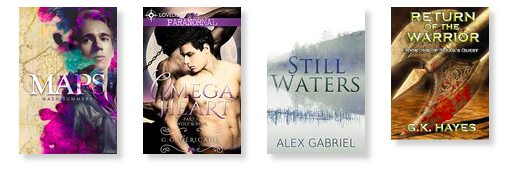
Maps (Life According to Maps, #1), by Nash Summers:
I completely adored this. It occasionally tripped over the line between funny and ridiculous, but not too often to make it anything but a fun read. I laughed so hard and so often that my cheeks cramped.
Wolf & Bear (Omega Heart, #1), by G.G. Géricault:
I flipping HATE serials. Seriously, what is the point? Why would I want just part of a story, with no conclusion? *sigh* Outside of wasting an hour on a story that ends before it accomplishes anything, the writing was fine and I liked the characters and story. If it was a whole story, I’d probably rate it fairly highly. But it’s not, so…
Still Waters, by Alex Gabriel:
I enjoyed this a lot. I liked that it’s told from the Nix’s perspective, complete with his confusion over human actions. I liked that it’s just barely a romance. Actually, it almost isn’t. What it is is an example of sex=love. The two heroes distrustfully circle each-other until they have sex and then it’s all good between them. But that’s really only a small part of the story. The writing is sharp and the editing clean. A+
Return of the Warrior (Sleag’s Quest, #1), by G.K. Hayes:
Return of the Warrior isn’t so much a story on its own as the first couple chapters in a longer adventure fantasy story. It reads well enough, though also in the tradition of adventure fantasy everywhere, I (as a female reader) was disappointed to find women only relevant in so much as they gave men reason to do things. All topped off with casual references to the indecipherable, turbulently emotional female mind. On the flip side, I was pleased that Sleag had his own moments of indecision and even tears at one point, though he wasn’t likened to the insane for them. All in all, if you’re the sort who liked quest fantasy and don’t mind the serialized format, it’s worth picking up.
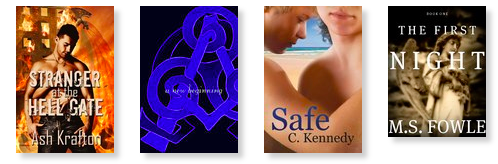
Stranger at the Hell Gate, by Ash Krafton:
I think if this had been further developed, given more character depth and world building it could have been something really nice. Instead, it just felt rushed and incidental. I didn’t feel any connection to any of the characters or the conflict and the ending was anticlimactic. The mechanical writing is fine, but the story just isn’t all that.
A New Beginning: Elyograg = Gargoyle, by Lorraine Beaumont
This is not a stand alone book AT ALL. In fact, another reviewer who read the rest of the series stated that this is literally the first chapter of the first book, so it’s not even its own piece of writing. Talk about a waste of time! What’s more, while the actual writing is fine the story if not. It starts out with something mildly interesting and then moves backwards through the day leading up to that point, getting progressively less interesting, until it is reduced to describing bedrooms and where people buy make-up brushes. Boring. And of course, you never learn anything more about the mildly interesting, unexplained thing that happened in the beginning.
Safe, by C. Kennedy:
Basically just a laundry list of what two boys do while exploring their sexuality form age 12-18. Unfortunately, it’s about as erotic as a laundry list too. All topped off with repetitive writing, heavy dependance on cliches such as the wealthy, larger, blond boy with a supportive family who protects the working class, smaller, Italian boy from an abusive family, and a sickly sweet, forced happy ending.
The First Night, by M.S. Fowle:
An interesting idea that I don’t think was particularly well executed. There seemed to be a problem with the timeline and the whole reason behind the roaming chimera never sat well with me. It was like a straw man set up to fight. The whole thing felt rushed and unfounded. The story could also do with a bit more editing. There were some odd word uses, like maybe English wasn’t the author’s first language (though I see from her bio that she’s from Maine). Like I said, interesting idea and twist on vampires, but ultimately a bit of a fail for me.
Elemental Inferno, by A.J. Locke:
Ugh, insta-lust followed by a series of dry sexual descriptions—we did this and then this and then this, instead of any sort of meaningful, buildup of tension and feeling—a paper thin plot, flat,undeveloped characters and a hero who is wholly without flaws. Not much to recommend it, honestly.
Lifeline, by Kit Power:
I don’t know that enjoyable is the right word for this one. It is, after all, a story of a man who is kidnapped for the purpose of being tortured to death. But it certainly keeps you on the edge of your seat. With the exception of one scene in the middle, which I thought dragged a bit, it was wire taut for the entirety.
Once Upon a Tiger (Tiger Shifters, #1), by Kat Simons:
The writing is fine here, but I’m afraid I’m just opposed to most of the plot on principle. We’re supposed to respect the heroine because she so strong that she refuses the mating run (which is basically an institutionalized rape of any women in estrus), but that ignores the fact every other female in the society is basically a broodmare who has no right to refuse to have sex when fertile and apparently has to submit to whomever can catch her (again, without the right to refusal). I mean that the whole act is predicated on running away kind of highlights that. And this run was instituted to prevent rapes……..um…….she (any she) can’t refuse……the main character here faces five men sent to mate with her against her will……..who will chase and mate her, even if she tries to refuse……even if she fights against it…..um………THAT IS RAPE. I suppose we’re supposed to assume no other woman wants to refuse. But really am I really supposed to believe that no other woman wants a career or wants to start bearing children as soon as she starts menses? Beyond all that, I didn’t feel the characters’ chemistry at all. They were supposed to have loved each-other for years, but they avoid each-other, basically almost never spoke. So, what was that love based on? The repeated “I love you” got incredibly redundant, the sex was abortive and formulaic and, if the need for child-bearing woman was so severe, I don’t buy she’d have been allowed to avoid mating in the first place, making the events of the book unbelievable to boot.
She’s Got Balls, by Mia Watts:
The plot is utterly contrived and unrealistic. It’s also probably an affront to women, because, really, with all of the FBI and police department to choose from, they couldn’t find a single woman more suited to go undercover AS A WOMAN than a man in drag? Not to mention the inability of the author to let a drug ring of suburban wives go without a man to lead and think for them. Grr. Why? But if I look past that, I found it an amusing read. Though I thought it would have been stronger without the rushed declarations of love.

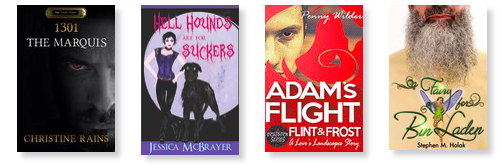
1301: The Marquis (The 13th Floor, #1), by Christine Rains:
An interesting start to a new series of novelettes. (It’s also a stand alone. I think each story is a different resident of floor 13.) I liked the idea and the characters. I especially appreciated that the heroine was a mature woman. But I thought the writing itself was only so-so. It was heavy handed and somewhat repetitive. But I’d be willing to read another if I came across it.
Hell Hounds Are For Suckers, by Jessica McBrayer:
This was a passable read. I thought it was absolutely ridiculous. But that was part of its charm, purposeful on the part of the author, I think. But that fell apart towards then end, when characters had drastic changes in behavior, the whole ‘romance’ element was thrown in and was just clumsily handled. I did think the writing was all right, except for one thing. Why do authors so often need to use names in dialogue so much? It’s like the fastest way to take otherwise passable dialogue and make it stiff and unnatural.
Adam’s Flight, by Penny Wilder:
An interesting set up and, I believe, faithful to the prompt, but I didn’t think the story flowed well. It seemed rushed in some parts and dragged in others. I appreciated the twist with Eli’s characters. It’s nice to see trans characters, but it didn’t seem relevant to the plot. Which to be honest wouldn’t have bothered me (because diversity is good and that’s a good enough reason to be there) except that it felt like just one more, ‘why is this here’ aspect. There seemed to be a lot of things that happened or were thrown in that were not particularly relevant and it made the story feel unfocused. I love dragons and dragon shifters, but I didn’t feel connected to Frost or Flint. I was excited about the romance, but it felt forced and sudden. All in all, I liked the idea of this story a lot more than the actual story.
A Fairy for Bin Laden, by Stephen M. Holak:
Short stories is not a genre I am overly fond of, but this one managed to be tightly compacted enough that I ended it happy. There is humor here and just enough description to carry you through. I don’t think it’s as long as it’s listed as, I finished it in about 1/2 an hour, but a fun read all the same. (Just don’t think too deeply about the logistics of it.)
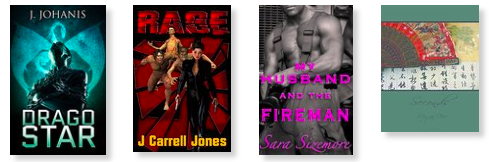
Drago Star (Toy Soldier Book 1), by J. Johanis:
Rape/torture porn. Yes, I knew going in that this was a kinky read by the BDSM group. I like an occasional kinky read. But this was just 65 pages of gang rape, topped off with a far too quick Oh Never Mind. This was way beyond my comfort level and I was just like nope, nope, nope, nope, nope all over the place.
Rage (Karen Bechard Adventures), by J. Carrell Jones:
The writing here was fine. It could do with a bit more editing, but mechanically it is fine. However, as much as I love a kickass heroine, even action can get boring if there is nothing else in a book. Rage is basically just Karen running from one heroic, action packed scene to another. She is just too calm and perfect at all times. There is nothing to her character but fighting, making yippee ki-yay type comments, defeating endless foes easily, getting the girl (and the guy and the job) and riding off into the sunset. Similarly, there is no reason given that the super-genius suddenly started an apocalypse or was utterly unable to maintain sanity in the face of Karen’s mere presence.
My Husband and the Fireman, by Sara Sizemore:
I do get my hands on some unexpected things sometimes and I’m not even sure how this made it onto my kindle. But it is exactly what the title suggests, no elaboration. The writing is simplistic, but it’s surprisingly enjoyable in that it happily glorifies in itself. It’s not trying to be gritty or literary or meaningful it is just married woman fluff with a happy ending. It’s a little problematic in that it’s unabashedly using gay m/m sex for the amusement and satisfaction of straight women (one in particular), which is appropriative, but in this too it is so up front about it that I have trouble remembering to be cross.
Seconds, by Megan Derr:
I do not think I’ve read a Megan Derr story that I didn’t enjoy. This was no exception. Cute.
*There are a couple in here with approximated lengths, as well as one or two catch-ups that should have been read for previous posts but got missed or updated page lengths.
 It is apparently a week for complaints. I promise I’m not always so negative. Actually, I’m usually pretty easy going. But I have my moments of, Jeebus, just stop already!

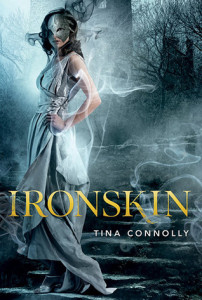 I borrowed