Angel Evolution

Book Review of David Estes’ Angel Evolution

Author David Estes kindly sent me a digital copy of Angel Evolution, book one of the Evolution Trilogy.

When Taylor meets Gabriel at college, she is in awe of the subtle glow that surrounds him. No one else, not even her best friend, seems to notice. Something about him scares her.
Is all as it appears? While Taylor struggles for answers, she finds herself in the middle of a century old war centered on one miraculous revelation: evolution.

Review:

**minor spoiler alert**

Let me say up front that I did like the book. I want to say that up front because I also have some complaints, gripes, criticisms. For one, Taylor and her best friend, Sam, have a certain innocence that appears contrary to their age. They are university freshmen, but Sam still interrogates Taylor excitedly over whether she is going to kiss her new boyfriend or not. I remember being a freshman, and a kiss was simply pase — 0r maybe I just hung out with the wrong type of girls. Either way the point is highlighted by the fact that, though Estes handles it delicately, Taylor quickly moves beyond kissing Gabriel. No one makes a big deal of this though. I belabor this rather small point for a reason. As is fairly common in YA books, the progress of Taylor and Gabriel’s relationship takes center stage in this book, largely eclipsing the danger threatening the entire human race.

Estes works hard to present Taylor as a quirky, knows her own mind, individual that most modern girls will identify with. I know I did. He also goes to some length to establish the strength of her gut instincts, how rare they’re wrong, and how she has learned to listen to them. She they goes right ahead and ignores them completely for the sake of a pretty boy. That she is aware of her own actions only makes it less believable. Unfortunately I feel like I could say the same sort of thing for both Gabriel and, his nemesis, Chris too.

Gabriel is presented as a smart, dedicated, goal oriented ‘angel’ on a mission, but with almost no provocation he falls in love and willingly throws away everything important to him. The problem is that it feels like this was a very sudden decision. There was no build up, and very little questioning of his situation or values before the decision is made.

Similarly, Chris is a clever, strong ‘demon’ trusted with an important mission that he doesn’t appear to actually complete, or even try to complete. Despite the risk to Taylor and all of humanity he doesn’t even try to engage or warn her, not even once. He takes the stance of an observer and suddenly against his (and Gabriel’s) very nature develops a peaceable, wait and see relationship with his enemy.

Now to end on a positive note, what I did like was the Carollian focus on the importance of names and titles. Should you trust someone simply because he has  a name that you’ve been taught is innately good and inspires positive feelings, despite all evidence to the contrary? Could you learn to trust someone who bore the title of an evil, despicable individual? How many kindnesses would it take before he could come out from under the shadow of his name? The whole scenario forces the reader to question their own beliefs.

Estes’ writing is also crisp and clear. It is a pleasure to read. While I have some serious complaints about the character development of Angel Evolution, it is still a story worth reading and I would recommend it for teenagers.

I am the Special Feature on bookr3vi3ws this month + INT giveaway

I’m really honored and excited to be D.D.S.’s first special feature author. The idea is fairly simple, get to really know and author and their book. So throughout the month of June you will find a weekly post about me and/or The Weeping Empress, and what better to start the whole affair off with than a giveaway? 

Head over to Bookr3vi3ws to fill out the rafflecopter to win your choice of a signed print copy or ecopy of The Weeping Empress. It is open internationally

Keep an eye out on the following dates:
8th June    – Author Biography
15th June  – Book Review
22nd June – Excerpt & Guest Post 
29th June  – Author Interview
Thanks D.D.S. for the chance to be part of such a fun event!

Review of Nadia Scrieva’s Drowning Mermaids

Deep under Arctic waters lies an ice kingdom carved into a glacier. Those who dwell within it possess magnificent biological secrets. Due to the dangers of impending war, the Princess of Adlivun is forced to flee her undersea utopia and regroup with her sisters in Alaska. Captain Trevain Murphy is a successful king crab fisherman who has spent his life building his empire above the sea, and knows nothing of the empire beneath it. When he meets a mysterious dancer whose father has recently died, he extends kindness towards her, unaware of her unique genetics and royal lineage. Trevain’s attraction to the enigmatic Aazuria Vellamo will involve him in dangerous designs that will forever change his life, and his perspective on himself and his world. He embarks on perilous journeys in which he will need to release all of his insecurities and inhibitions in order to survive.

Review:

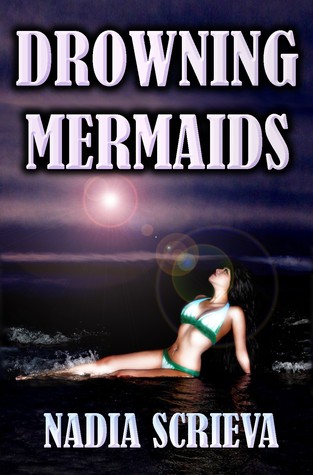
I was a little wary of Drowning Mermaids (Sacred Breath, #1) at first. The cover made me think it might be more smut than anything else, but the synopsis really looked interesting and it has good reviews, so I decided to give it a chance. I’m glad I did.

I’ve seen the author refer to the story as Darwinian Mermaids, and that’s a fairly good description. Aazuria and her elegant entourage are no Ariel. They don’t have shining scaled tales. They don’t use sea shells in poor attempts at modesty (and even less so for support), and they know human culture fairly well. They do, however, have an overbearing and questionably protective sea king as a father, so I suppose there are similarities.

One of the things I liked about Drowning Mermaids is the idea of mastery, the idea that given time (of which the mermaids have an abundance) humans can truly master an art. Scrieva doesn’t present her mermaids as magical, spell-binding holders of innate power over the senses of humanity. Instead, they are skilled, carefully trained, and practiced. It reminds the reader that if even mythical creatures have to work at what is important to them, we can’t expect to do any less.

The mermaids do seem awfully up on modern language, medical terminology, and weaponry. I found this a little hard to accept, considering their recent circumstances. Scrieva handles the language difference between land and sea people marvelously, but I thought the comfortable use of Methemoglobinemia, for example, stretched the credibility a little too far.

Despite this, without a doubt, the highlight of the book was the actual writing. Scrieva’s ability to infuse a slight sense of irony into even the most somber passage was a sheer joy to read. The occasional use of sarcasm at the expense of the characters makes the reader feel party to a private joke and creates a comfortable intimacy. For this reason, more than any other, I’ll be picking up the sequel Fathoms of Forgiveness (Sacred Breath, #2).