You know, for someone who says they don’t tend toward reading short stories I sure read a lot of them. This year especially, since I’ve set myself a goal of clearing them off my shelves.
I’ve been clustering them into individual posts, mostly by page lengths but occasionally other themes like duologies or shorts I’ve received as review requests. That’s what this post is. ‘Books’ fewer than 100 pages (most of which are technically novellas, but I still call them short stories in my head) that have come to me from authors with a request for review.
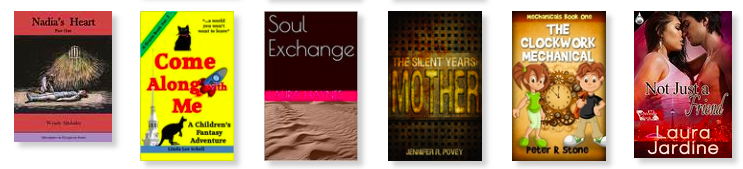
I won’t lie, none of these really grabbed my attention before reading them. I mean, three are children’s stories, one is a third in a series and one is ‘spiritual,’ which I suspected meant religious (a no-go in my reading preferences). So, they started with a little bit of a challenge. But I promised to give them a fair chance at impressing me, judging them on quality not necessarily my own enjoyment.
This turned out to be harder than I expected. Perhaps it’s just coincidence, but I seemed to encounter more problems than normal among this particular selections of texts—everything from poor editing to incomplete files—so much so that at one point I considered scrapping the whole post. Unfortunately, I’m not the sort who likes to give up on something once started.
Nadia’s Heart (Evergreen Series), by Wendy Altshuler: I’m afraid I gave up on this at 37%. And while I wouldn’t normally include a DNF here on the blog, I am now since it was part of a preselected cluster. I had numerous problems with this, but the most important of which was that things happened out of the blue with no explanation and I was simply lost for the vast majority of the time I was reading.
Secondarily, I never felt I connected with Nadia or anyone else. While I’m not someone who holds that the show-don’t-tell dictum is a universal, this story is almost wholly tell and I think this was to its detriment. Tell is difficult to engage a character through and that just exacerbated the fact that the reader doesn’t get to know Nadia before she goes on her trek. The story starts with an info-dump about her. We learn she’s 12, she’s inquisitive, she’s a tomboy, she thinks she has no heart, and she lives with an old man and old woman. We learn about her, but we don’t get to know her. All of which makes it hard to care about the mysterious journey she goes on.
In the course of that mysterious mission, I often didn’t know who people were, characters reacted to events we weren’t told happened, groups of people were so poorly differentiated that I didn’t immediately recognize that there were two, let alone which was doing what, and shadow characters were presented and disappear without explanation.
None of this is helped by the total dearth of world-building. It’s so scarce that I couldn’t even decide on what type of world it was. Modern, Steam, Victorian, Medieval, something new? I was also utterly baffled by the anachronisms, both in language and in the world itself. They knew about electricity, detailed human anatomy and astronomy to a degree that would require fairly modern technology but didn’t have running water. I sensed that this was all a case of simply not having been considered.
Mechanically the writing is fine, but structurally the story is a mess.
Come Along With Me (Gracie series #1), by Linda Lee Schell: I was sent this book for review…or I thought I was. Turns out I was sent the first chapter. Based on that I’d give this a two out of five stars. The problem I see is that it doesn’t seem to know what age range it wants to aim for. It says it’s or 8-12 year olds, but I have an 8yo and she would struggle with some of the language of the book and be disturbed by some of the events. But anyone older would likely be put off by how fluffy it is.
Soul Exchange, by Laura Haynes: Perhaps I have an old, uncorrected copy (though nothing identifies it as such) but the best I can say for this is that it’s an interesting idea that needs quite a lot more development and editing before it’s ready for publication and consumption by the public.
The Silent Years: Mother, by Jennifer R. Povey: This was a really good character-driven zombie apocalypse story…or at least zombie-like. Dorothy is a bit of a Scarlet O’Hara, eminently dislikable but with a strength and fortitude that you just have to appreciate. You may not like her, may not even want to know her, but when the shit hits the fan you want her on your side. Not because she’s some tough as nails bad-ass bitch, which is the way so many authors think they have to write a woman to make her “strong.” No, it’s because she’s practical to a fault, practical to the point of survival, despite herself. And it seems to me that in the face of the end of the civilized world, this is what we’ll need. Also, to be fair, a lot of what makes her so dislikable she does grow out of by the end of the book. All-in-all, a full on success, I’ll be looking for more of Povey’s writing.
The Clockwork Mechanical, by Peter R. Stone: Fairly simplistic, but passable as it is intended for elementary aged children. I’d have been more pleased with it if the gendered characterization of the characters wasn’t so painfully clichéd, the girl especially. I’d intended to pass this to my kids when I finished, but I’d rather they not have to read the reinforcement that girls are silly, unintelligent, distractible, talk too much, and need constant rescue from disasters of their own making. The larger cultural script this plays into is of course, “See boys, this is what happens when you let silly little women have too much independence. Thy just can’t help themselves and it falls to you to rescue them in the end. Best to just keep them under thumb from the beginning.” Ugh, we can do so much better. The boy of course, is honorable, smart beyond his years, heroic and brave.
Not Just a Friend (Toronto), by Laura Jardine: This was a cute little contemporary romance. I liked Liam. He was a refreshingly non-alpha-A-hole hero. I appreciated that Maya was allowed a sex life without being painted as a slut. But I also thought the story was repetitive, her bad dates were over-played and the whole thing seemed to go on longer than necessary.

 I purchased a copy of Technologies of the Self ( Haris A. Durrani) from Brainmill Press.
 I borrowed a copy of