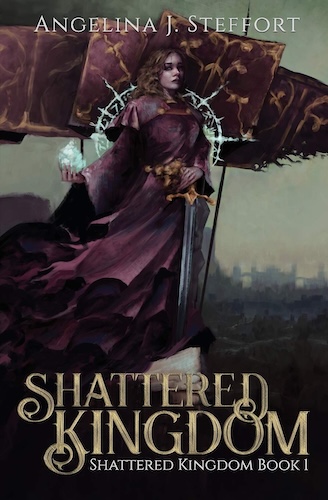
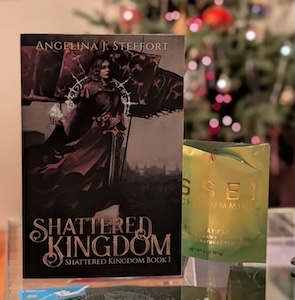
I think I won this copy of Angelina J. Steffort‘s Shattered Kingdom. I do not recall where from; however. Unfortunately, this is a book I found on my shelf that I had forgotten about. It’s a new year, and I’m setting a goal to be better about reading my physical books, and this is a perfect example of why.
Sworn to a goddess. One with her blade. A heart yet unbroken.
It would have been only one more year of training. One year in the dust and wind of the Calma Desert. But Gandrett Brayton’s fate storms in disguised as a beautiful stranger with a damning secret.
As he forces her into the service of the lord who tore her from her mother’s arms ten years ago to commit her to the Order of Vala, Gandrett is left with a choice: run, or work for the man she despises and earn the chance to see her family again.
Trained with all the weapons she can wield with her hands, Gandrett must learn that at the courts of the shattered kingdom of Sives, her sword won’t help her– especially when it is her own heart on the line.
This was fine, if overly long and, consequently, feels slow. I liked the characters, and the world seems interesting. However, it’s very, very focused on the I’m not like other girls heroine who embodies just about ALL the cliched YA heroine tropes. She’s not clumsy in a trip-over-her-own-feet way (though she is socially graceless, which might check the same box). But just about every other cliche is there. Which means nothing here feels very original.
I got annoyed with four main issues, though. These aren’t necessarily problems, just things that annoyed me. First, for being such a fantastic fighter, she does amazingly little fighting and loses every time. Second, she grew up in an isolated group, learning to fight. The effects of that should have been visually and linguistically apparent, not just in scars. This book takes no account of accents and the physical effects of a brutal lifestyle when it decides a warrior from a remote outpost is the ideal person to disguise as a lady. Third, I was annoyed that every boy/man she encountered fell for her hard and fast, and she didn’t notice. (Yep, it’s a YA trope, but it annoyed me.) And last, Nehelon’s obsession/love gave me the ick. It wasn’t the hundreds-of-years age gap. That’s pretty common in fantasy romance. It was the way she was underage, and he started obsessing over her from afar without her knowing or doing/participating in anything to provoke or encourage it. The reader is given no real reason for it. Like, there is no point when we saw him start to fall in love with her or to appreciate anything about her as a person. It felt very old-man-lusts-after-young-girl, very pervy uncle who’s just waiting for her to be legal. This is a longish series, and I think probably nothing will happen until she is older. But it still felt icky to me here.
All in all, despite my annoyances, the book kept me entertained for the time I spent with it. If I came across the rest of the series at the library, I’d likely read it. I don’t think I’d buy it, though.
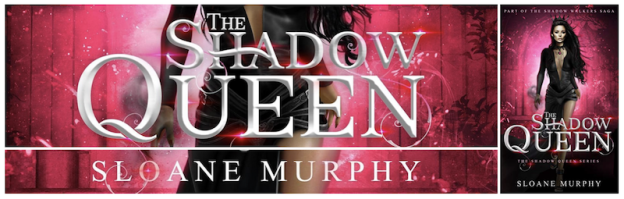
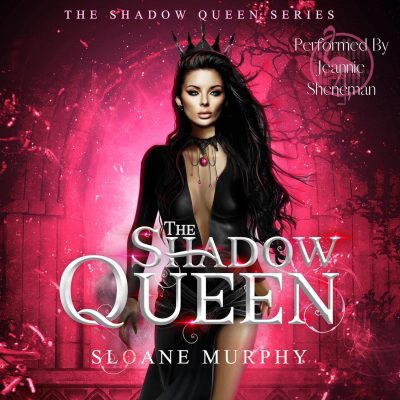
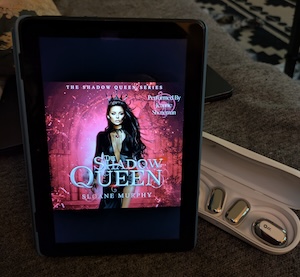
Quite some time ago, I received an audio code for a copy of Sloane Murphy‘s The Shadow Queen (narrated by Jeannie Sheneman). Unfortunately, I started a university program shortly after that and ended up with very little time to listen to audiobooks. So, it’s been sitting in the cloud since then. I finally got to listen to it.
Once upon a time, there was a princess who lived amongst the shadows and monsters…
Pampered and coddled, Morganna didn’t know any different, until her father took the person who mattered most away from her.
The brutal lesson taught her the truth. Nothing in her world is given. If you want it, you have to take it.
What she wants now is revenge and she will take the thing that matters most to her father.
She will claim The Shadow Realm… and it will be hers.
Meh, I thought this was mediocre, but it basically skirts by as fine. I have no desire to continue the series, but I didn’t dislike the book enough to DNF. So…I guess it is what it is. It felt like it was written with a lot of tropes, but not much of an apparent plot until right at the end.
The reader barely gets to know anyone. The character descriptions are very shallow. This is made worse by the fact that just about the time you get used to one mate, he gets left behind while the FMC goes off with the next. It felt abrupt and a bit like a betrayal. And I did not find the pseudo-noncon humiliation kink/trope to be a positive replacement. I could have done without that entirely. I suppose that leaves room for character development and growth on the part of mate number two. But since I won’t be around for it, the whole thing just left a bitter taste.
I found the descriptions of the FMC really inconsistent. She’ll threaten to kick someone’s ass, but she’s so weak and untrained. She talks like such a badass, but she’s so sheltered and untried. She’s so powerful, but completely unaware of what she’s capable of, and is chronically underestimated. She’s a princess, but not like other royals or girls. (She actually uses the phrase “I’m not like other girls” about herself, even.) This last one begs the question: if she’s raised in the same environment as everyone else, how did she and her brother miraculously turn out to be different?
Lastly, let’s talk about the “Fucks.” Look, I curse like a sailor and fully understand that a well-placed “fuck” can be very effective. So, I am not being prudish when I say this. But the word is used far, far, far too frequently in this book. It is so often unnecessary in the sentence that it clutters the dialogue, and, worse, makes all the characters sound the same because they all sprinkle it liberally in their speech in precisely the same way. Eventually, it just started to grate on my nerves.
Look, I’m not saying this was a bad book. It’s readable, and the narrator did a fine job. But I am saying it didn’t do anything for me. I just got to the end and was annoyed with it.
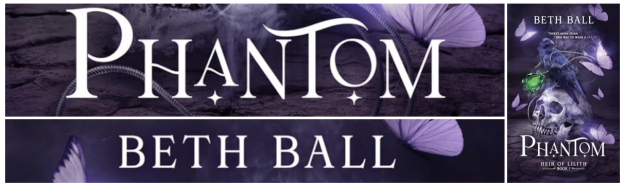
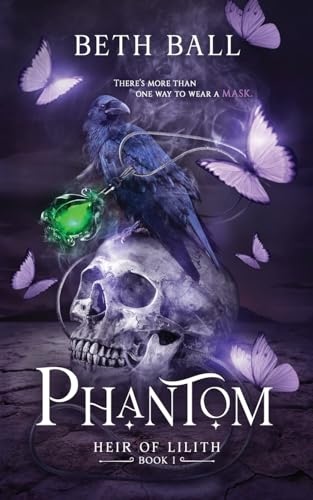
As the assassin for his duke, Lord Silas Graveston’s world is clear-cut—protect his liege, protect his family name and honor, and the rest will take care of itself… Or so he believed until three years ago, when his aunt was attacked in the capital and his family’s emerald necklace stolen.
When the emerald choker appears upon the neck of his long-sworn enemy’s new courtesan, Silas knows he’ll stop at nothing to get it back.
But Silas isn’t the only one engaged in a deep masquerade, and he’s not the only assassin in the queen’s court. The threat of violence is a familiar shadow for Natalya Slipshayde, an ever-present force following her every step. She has no family, no code. All she needs is a way out.
Unfortunately for them both, the webs of Draykemire are more intricate than even the most skilled assassin can navigate, and there are predators lurking at every turn.
TL;DR I hated it.
This is admittedly rambly, as I’m mainly trying to convey the vibes. But I got so much ick from this book. I doubt it’s what the author intended, but everything about it felt incredibly patronizing. It is a patriarchal fever dream. Polygynous, except that the women don’t even get the legal or social protection of being a ‘wife.’
Ball chose their title well; these are courtesans. And of course, a courtesan is a “prostitute with a courtly, wealthy, or upper-class clientele.” As far as I can tell, they’re schooled, trained, and then hired or purchased. Their patriarch/husband/John is called a Suzerain, but it sure felt like owner/master to me. Cortesians are counted among a nobleman’s assets after all. Sure, ideally, they have some agency in whose offer they accept, but once accepted, the Suzerain seems to basically own them. The man is the head of the household, making all decisions. Women (or at least some women) don’t speak until acknowledged by the man first; they stand when he enters a room and don’t sit again until he does, he names them (and names them in relation to what they bring him or he enjoys about them—Comfort, Vice, Pain etc), they are sexually available to him at his whim, and their reproductive labor is his to claim. He holds ALL the power, socially, financially, legally, politically, and so on.
I think it’s the inconsistency that irked me, though. They’re courtesans in the truest sense. But Ball wants them to come across as family. And sure, in theory, I could get on board with this being an alternate society where that’s the case. But it just didn’t work for me. What I saw instead was a familial scenario in which everything revolves around men and their women-shaped toys, all smoothed over by etiquette and benevolent sexism. And ultimately, when I sit down to read a romance novel, I want romance. As a female reader, I especially want to feel that the woman is special to the man in the relationship. I didn’t feel that here. I feel like I just read about a man and the interchangeable whores he’s fond of, has some moderate affection for, and therefore treats well. Meh.
Honestly, having said all of that, if I hadn’t seen Beth Ball’s author photo, I’d swear a man wrote this. That feels like a reasonable explanation for it all. Not just because of the strictly male-headed hierarchical family relationship. But also because all of the women are reduced to old, stale stereotypes. There is a single cold, duplicatous woman in possession of power. The jealous, cruel older woman who sees herself as scorned, the youthful skipping, giggling second ‘wife’ who brings child-like joy to the man’s life, and the FMC who is supposed to be smart, strong, and skilled but still somehow needs the man to rescue her and submits to him happily, while not being like other girls. As well as the tone and thought processes of the male lead, from whose POV most of the book is written, and the fact that the book almost doesn’t pass the very low bar of the Bechdel Test.
Plus, there’s just a whole sense that the men (even the guards) understand the way of the world in a manner the women do not. They then allow the women their illusions, acquiescing to their naive games and watching over them with paternal/patriarchal care. It’s all just kind of…Well, I bet a conservative/fundamentalist Christian would feel right at home. Hell, I hardly even think the multiple wives would be all that off-putting so long as they showed the deference of gracious submission as these cortesans do their masters.
And look, this is listed as dark romance (though it’s not particularly dark, to be honest). It’s not that I expected it to be a paragon of feminism. It’s just that I’m so tired of the same recycled social orders. Honestly, even I’m a little surprised by how exhausted reading this made me. I think I would have been more tolerant of the whole system if courtesans (and nobles, for that matter) could be of both male and female genders. If Ball had thrown in a chevalier or something. (There is a single mention of a noblewoman and her consort about 3/4 of the way through. But that is the only reference in a system that is wholly gendered for the entirety of the rest of the book, and I’m not even sure he was meant to be the equivalent of a courtesan.) If there had been more gender parity among both courtesans and nobles, the whole thing wouldn’t have felt so gendered and tired then. I know I’ve used that word, tired, more than once. But it’s honestly how I feel about the whole thing. Just imagine a person who is tired of something, encountering it again, and again, and again, but is also just too exhausted by it all, even to be piqued to ire.
Add to all of this the cardboard cutout FMC and my intense dislike for the MMC. True, almost everyone else is shown to mistreat their courtesans, some horribly, and no one seems to blink (which says a lot about the place and protections of courtesans). The MMC is, of course, appalled, and the reader is meant to see that he is so much better than the rest. This is supposed to reflect well on him. But he still exists within and supports the system. He still holds all the power. He could, at any moment, decide to treat his courtesans just as poorly as we see others do, and there would be no recourse. (He all but dismissed Comfort, who had been with him since he was a teen, with ease, and anted Vice up in a bet, for example.) This makes him complicit in the system, and nothing in his surface-level kindness to his own courtesans made up for it.
And yes, the romance between Phantom and Pain is written to be a grand love, something more than what the MMC has with the others. But so was his passion for Comfort once, and his love for Vice, cooled, but still alive. How am I to believe there is a true romantic HEA here and not just another burst of passion that will pass with her replacement? It all just felt like a business transaction. He bought himself a new fancy lady, and she’s playing the role of his most novel courtisan, just as Vice is his youthful (childish) joy, and Comfort his useful social bridge (almost out to pasture). And we mustn’t forget that she was hurt by his bringing Vice into the family, and then again when he brought Pain in. So, her feelings were not important in the face of his desire for a new toy. Nor were they when he literally “gave no thought to the soft sob that sounded behind them” as he and Pain walked away. This is a romantic lead? Not in my world.
I’m not claiming this is a bad book. If someone wants a romance steeped in the patriarchy, this will light them on fire. I, however, hated it. I mean, really hated it. There’s no point in even getting into any technical critiques I have. I just hoped for so much more. So, while the writing here is fine, it was not a winner for me.

 when we saw him start to fall in love with her or to appreciate anything about her as a person. It felt very old-man-lusts-after-young-girl, very pervy uncle who’s just waiting for her to be legal. This is a longish series, and I think probably nothing will happen until she is older. But it still felt icky to me here.