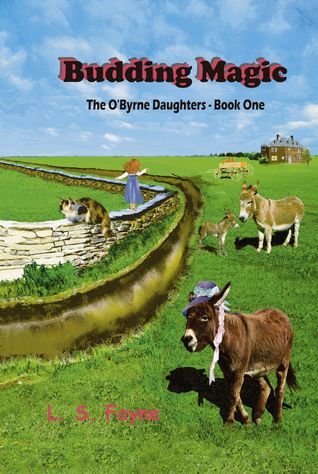
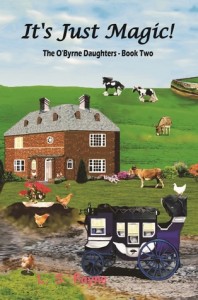
These two books comprise one continuous story, and if I had one significant change to make it would be combining them into one. The unfortunate logistics of modern publishing makes this unrealistic though, since it would be too long to be marketable. This is simply too bad.
The story revolves around the six (actually seven but one is only a baby and doesn’t have much of a role) O’Bryne sisters. Their parents have just died, leaving them orphans in pre-potato famine Ireland. Luckily for them, their family is descended from a goddess, notorious magic users, and predominantly good, loving people. Despite grieving and facing a steep learning curve as the trauma of their parents death prematurely awakens their budding magical powers they support each-other and everyone around them.
If I’m honest, the covers of Budding Magic and It’s Just Magic almost put me off offering to reading them. There isn’t anything actually wrong with them. They just didn’t particularly appeal to me, too many bright colors for my rather drab personality. The story did though, so I reminded myself of the old adage ‘never judge a book by its cover,’ and I’m glad I did. It’s an engaging story that carries you along pleasantly. Or at least it does after chapter one of Budding Magic. I cried in the first chapter, yes the first chapter!
Each of the six sisters has a personality of their own, which can’t be easy for a writer. You easily become attached and invested in their adventure. It is fun learning the Druadic lessons with them and seeing how Fayne describes all of the magical creatures. The language is distractingly modern for a story set in 1838, especially that of the O’Byrne sisters, but this is easily overlooked. If you like fairtale fare you’ll like these books.
It is a testament to the O’Brynes that I enjoyed the story as much as I did despite having one of my number one literary pet peaves in it. This is when main characters are presented as more morally advanced than their peers because they adhere to normal modern civic mores. It comes through in little things like insisting on bathing regularly in a historical time period when hygiene was neither understood nor appreciated, or expecting fair labour (or gender) laws in what would otherwise be a feudal state. Express a desire to see change, sure, but surprise that others adhere to what would be the norm of the day, no. Like everyone else, the main characters would know no different. I generally find it smug and condescending, and Fayne’s story is no exception. Despite this one major drawback for me, I really liked Budding Magic and, to a lesser degree, It’s Just Magic.
I say to a lesser degree because there is so much recap in book two. I don’t mind a dozen or so pages at the beginning of a sequel to bring the reader back up to speed, but in It’s Just Magic theses reviews run the course of the whole book. 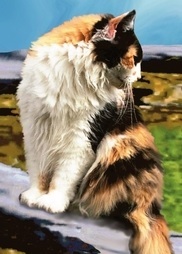 Even in the last chapter one finds, “Calley-Cat had….” and a quick rundown of what good old magical Cally-Cat did in book one. Don’t get me wrong, I still liked the book. The O’Bryne sisters have a certain vivacious innocence that charms the reader. But there are a lot of characters and goings on in Budding Magic that It’s Just Magic tries to remind the reader of. This tends to eclipse the story being told, which is a shame. It’s a good story, full of angels, goddesses, succubi, unicorns and magical calico cats. The children’s nascent magic is interesting, and there is even a splash of romance.
When all is said and done, the story of the Irish O’Bryne’s is one worth the read for those who are 14ish and up. There are a few sexual references, more often than not when a baddie needs to be seen as especially depraved. But there is no explicit sex or violence.
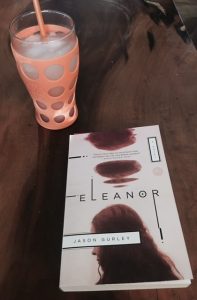 I received a copy of Eleanor, by Jason Gurley from Blogging For Books.
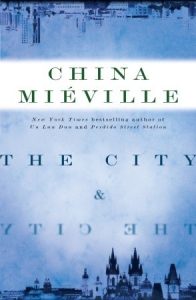 About the book: