Tag Archives: book review

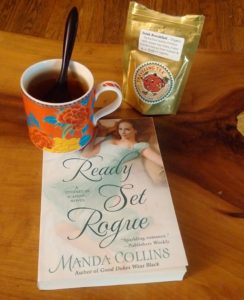
Book Review of Ready Set Rogue (A Studies in Scandal #1), by Manda Collins

I won an ARC of Ready Set Rogue, by Manda Collins, through Goodreads:

Description:
When scholarly Miss Ivy Wareham receives word that she’s one of four young ladies who have inherited Lady Celeste Beauchamp’s estate with a magnificent private library, she packs her trunks straightaway. Unfortunately, Lady Celeste’s nephew, the rakish Quill Beauchamp, Marquess of Kerr, is determined to interrupt her studies one way or another…

Bequeathing Beauchamp House to four bluestockings—no matter how lovely they are to look at—is a travesty, and Quill simply won’t have it. But Lady Celeste’s death is not quite as straightforward as it first seemed…and if Quill hopes to solve the mystery behind her demise, he’ll need Ivy’s help. Along the way, he is surprised to learn that bookish Ivy stirs a passion and longing that he has never known. This rogue believes he’s finally met his match—but can Quill convince clever, skeptical Ivy that his love is no fiction?

Review:
I’d give this a 2.5-3 stars if I was using stars, here on the blog. I very much appreciated that Ivy was self sufficient and frequently acted with a lot of agency. I liked that there was a character likely meant to be on the autism spectrum, a severe introvert and a single mother who had overcome her own past trauma.

However, I felt the plot was a weak one. It’s basically insta-lust that bloomed into love out of nowhere and the mystery was just an excuse to throw the characters together. This impression solidified when the villain announced themself before the characters identified them and told their whole plan, start to finish, with no prompting. Such that the characters didn’t really have to solve the mystery in the end. I also felt cheated that after all the build up, we never saw the end result of the romance. That was all off page.

My main complaint however was that Quill, the hero, notably WAS NOT A ROGUE. If I pick up a book called Ready Set Rogue, I expect a rogue. Quill is a single man in a historical romance novel, and I suppose the term rogue is morphing to mean just that, but I still consider a rogue a ‘dishonest or unprincipled man,’ a ‘knavish person’ a ‘scoundrel.’ Quill is polite, principled, loyal and not even a player. He’s a gentleman in every way—politically, socially and behaviorally—NOT A ROGUE. This annoyed me to no end.

I was reading an ARC and there were some pretty significant discrepancies in the time line and contradictions in event, but I have every faith that these will be cleaned up before the book’s final print run. That the repetitive phrasing, over-use of ‘bluestocking,’ and anachronistic language will be isn’t as guaranteed, but it was readable even as an ARC.

As an aside, I don’t think the cover fits the tone of the book or the description of Ivy (who was curvy with glasses), but that’s just my opinion. I’m not a huge lover of historical romances, so there’s a chance someone who is will overlook those things that so annoyed me. All in all, I found it to be an OK read, not bad but not very good either.


What I’m drinking: organic Irish Breakfast tea form the Traveling Tea Shop.
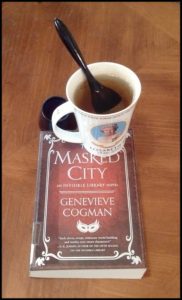
Book Review of The Masked City (The Invisible Library #2), by Genevieve Cogman

The Masked CityI borrowed a copy of Genevieve Cogman’s The Masked City from my local library.

Description from Goodreads:
Working in an alternate version of Victorian London, Librarian-spy Irene has settled into a routine, collecting important fiction for the mysterious Library and blending in nicely with the local culture. But when her apprentice, Kai—a dragon of royal descent—is kidnapped by the Fae, her carefully crafted undercover operation begins to crumble.
 
Kai’s abduction could incite a conflict between the forces of chaos and order that would devastate all worlds and all dimensions. To keep humanity from getting caught in the crossfire, Irene will have to team up with a local Fae leader to travel deep into a version of Venice filled with dark magic, strange coincidences, and a perpetual celebration of Carnival—and save her friend before he becomes the first casualty of a catastrophic war.
 
But navigating the tumultuous landscape of Fae politics will take more than Irene’s book-smarts and fast-talking—to ward off Armageddon, she might have to sacrifice everything she holds dear….

Review:
Darn it, this is the second book in a row that turned out to be a second in a series. Unfortunately, with this one I didn’t realize that it is a sequel until at least halfway through. It’s definitely followable without reading the first, I just had to overlook the references to action from book one. Doable, but annoying.

I generally really enjoyed this. I liked Irene as a heroine. I liked how it turned the damsel in distress trope on its head by having her save her male apprentice. Some of this was compromised by the fact that she had to beg a king and a male fae for assistance and a male side character came to her rescue, but in the end she rescued him too and carried the day (with the assistance of two men, but who’s counting). She was definitely the initiator of most of the action. Yay. I thought the dialogue was brisk and there was a lot of humor. But I thought the writing was repetitive and occasionally overblown.

I was consistently irritated to have the otherwise adult narrative interrupted by Harry Potter-esque magic, such as magical, inter-dimensional traveling wardrobes characters climb in and out of. And I flat out hated the Language (which is a magical ability). Every single one of her blunt magical directives read as cheesy and unbelievable, not to mention too convenient for comfort.

Perks for having women in positions of power, even if predominantly in the background, giving most the active authoritative positions to men. And extra perks for allowing for more than het seductions and the presence of at least one gender queer character.

Lastly, I would have liked one more chapter at the end, showing what happened to Irene once she returned to the library and faced her superiors, but I did enjoy the bonus content the reader is given instead. (Just not as much as I’d have enjoyed a little more wrap-up to the plot.)


What I’m drinking: Generic, loose-leaf green tea. As in, I put it in a pretty little tea tin and no longer remember where it came from or what brand it might be. As far as I’m concerned, it’s just green tea. It’s a nice brew though.

Year of the Demon

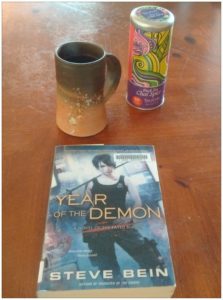
Book Review of Year of the Demon (Fated Blades, #2), by Steve Bein

Year of the DemonI borrowed Steve Bein‘s Year of the Demon from my local library. I have thousands of books on my Kindle and I still can’t help going out and finding more.

Description from Goodreads:
Detective Sergeant Mariko Oshiro has been promoted to Japan’s elite Narcotics unit—and with this promotion comes a new partner, a new case, and new danger. The underboss of a powerful yakuza crime syndicate has put a price on her head, and he’ll lift the bounty only if she retrieves an ancient iron demon mask that was stolen from him in a daring raid. However, Mariko has no idea of the tumultuous past carried within the mask—or of its deadly link with the famed Inazuma blade she wields.

The secret of this mask originated hundreds of years before Mariko was born, and over time the mask’s power has evolved to bend its owner toward destruction, stopping at nothing to obtain Inazuma steel. Mariko’s fallen sensei knew much of the mask’s hypnotic power and of its mysterious link to a murderous cult. Now Mariko must use his notes to find the mask before the cult can bring Tokyo to its knees—and before the underboss decides her time is up….

Review:
This is a hard one for me to rate because I didn’t read the first (Daughter of the Sword) and I don’t know how many of my complaints are the result of that. For example, I knew Mariko carried over from book one, but until I finished this book and glanced at some other reviews, I didn’t realize one of the historical characters does too. Certainly, I followed and enjoyed it, but my largest issue was that I didn’t feel like the three plot lines converged in any way, such that I felt like I’d read three partial stories instead on one cohesive whole.

Sure, they all involved the sword and mask, but that’s the only connection and surely in the 500 or so years between the events, other people held them too. So, why these particular stories? Kaida’s arc seemed especially anchorless. Would this have been different if I’d read book one? Maybe. But since the two books are apparently in the same style, jumping between the past and present, I’m thinking not. I just might have more faith that the plot lines will connect in some future book.

I very much liked the characters. There is some parallels between Mariko and Daigoro’s situations and the difficulty of doing the honorable thing. I liked that sex was dealt with very matter-of-factly. The writing is lovely, though a bit repetitive, with some editing mistakes (most notably, I think in some of the dates, as they made no sense). Despite being set in Japan, having a few Japanese words thrown in here and there and people bowing, the narration and dialogue didn’t sound particularly Japanese. This was especially notable in the historical dialogue. I liked it and its obvious the author did a ton of research, but it felt very American.

All in all, I suppose I liked but didn’t love this book. But I feel like I really aught to have.


What I’m drinking: Tea of Life Black Chai. I’ve been drinking it plain, not milky, which is my preference. But I find chai from a tea bag is never strong enough to make a nice milky version.