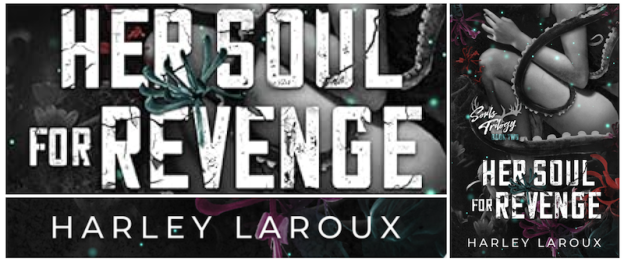
After a cult tried to sacrifice me to their wicked God, I went on the run, doing whatever was necessary to survive. Until a demon offered me a deal: give him my soul and he’ll help me claim the vengeance I seek. Blood will be spilled, and the monsters I once ran from will soon be running from me. But damning my soul was just the beginning; it’s my heart the demon wants next.
Zane
I’ve been hunting souls for centuries, but she’s the ultimate prize. Vicious and feral, she has a broken soul as dark as my own. I thought claiming her would be a simple game, but Juniper is far from simple. I chose to follow her on a path drenched with the blood of her enemies, but it’s our blood that may be spilled next. As an ancient God wakes from Its slumber, neither of us may survive.
Her Soul for Revenge is book two in the Souls Trilogy but can be listened to as a standalone. It contains sexual scenes including kink/fetish content, horror elements, drug use, scenes of trauma, anxiety, and PTSD.
I tried, I really tried. I checked out this audiobook from the library, but I had to renew it 2 more times before I managed to finish it. (Goodreads says I started it Dec. 12 and finished it Feb. 7!) Honestly, I should have just DNFed it, but I’m nothing if not stubborn. I think, maybe, there just wasn’t enough new to the story to keep me interested. The events of the book are basically what a different couple is doing simultaneously to the couple in book one. Which means there’s not much in the line of new plot points to hang this romance on. I was bored stiff. And because I was bored, I never got particularly invested in the characters or their romance. So, the smut didn’t even interest me. Honestly, I started fast-forwarding through a lot of it (and it still took me weeks to reach the end).
As a side note, that couldn’t have helped my opinion of the book. I found that when listening to this smutty book with an a-hole alpha-y male lead and humiliation and power dynamic tropes, I really REALLY hated having a male narrator read it to me. I could not seem to get the distance needed to keep it in the remember-the-character-likes-it, he’s not just being a dangerous real-world misogynist, realm of fantasy. I couldn’t help imagining how much a real-world man (male narrator) enjoys getting to indulge in what, outside of fantasies, is pretty toxic and abusive behavior around women and sex. I’m not saying the narrator did or does (or that he did a bad job with the narration), but I couldn’t get the distance to separate him from the shit in the book. There are just far too many systemic attacks on women (by men) in our society, at the moment, and it’s bleeding into my reading. This was a lesson learned, and I will avoid male narrators for such books in the future.
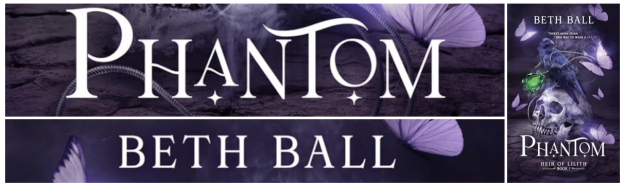
As the assassin for his duke, Lord Silas Graveston’s world is clear-cut—protect his liege, protect his family name and honor, and the rest will take care of itself… Or so he believed until three years ago, when his aunt was attacked in the capital and his family’s emerald necklace stolen.
When the emerald choker appears upon the neck of his long-sworn enemy’s new courtesan, Silas knows he’ll stop at nothing to get it back.
But Silas isn’t the only one engaged in a deep masquerade, and he’s not the only assassin in the queen’s court. The threat of violence is a familiar shadow for Natalya Slipshayde, an ever-present force following her every step. She has no family, no code. All she needs is a way out.
Unfortunately for them both, the webs of Draykemire are more intricate than even the most skilled assassin can navigate, and there are predators lurking at every turn.
TL;DR I hated it.
This is admittedly rambly, as I’m mainly trying to convey the vibes. But I got so much ick from this book. I doubt it’s what the author intended, but everything about it felt incredibly patronizing. It is a patriarchal fever dream. Polygynous, except that the women don’t even get the legal or social protection of being a ‘wife.’
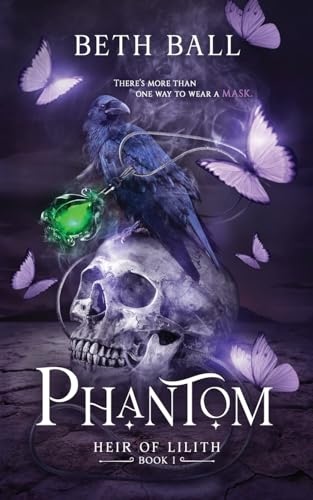
Ball chose their title well; these are courtesans. And of course, a courtesan is a “prostitute with a courtly, wealthy, or upper-class clientele.” As far as I can tell, they’re schooled, trained, and then hired or purchased. Their patriarch/husband/John is called a Suzerain, but it sure felt like owner/master to me. Cortesians are counted among a nobleman’s assets after all. Sure, ideally, they have some agency in whose offer they accept, but once accepted, the Suzerain seems to basically own them. The man is the head of the household, making all decisions. Women (or at least some women) don’t speak until acknowledged by the man first; they stand when he enters a room and don’t sit again until he does, he names them (and names them in relation to what they bring him or he enjoys about them—Comfort, Vice, Pain etc), they are sexually available to him at his whim, and their reproductive labor is his to claim. He holds ALL the power, socially, financially, legally, politically, and so on.
I think it’s the inconsistency that irked me, though. They’re courtesans in the truest sense. But Ball wants them to come across as family. And sure, in theory, I could get on board with this being an alternate society where that’s the case. But it just didn’t work for me. What I saw instead was a familial scenario in which everything revolves around men and their women-shaped toys, all smoothed over by etiquette and benevolent sexism. And ultimately, when I sit down to read a romance novel, I want romance. As a female reader, I especially want to feel that the woman is special to the man in the relationship. I didn’t feel that here. I feel like I just read about a man and the interchangeable whores he’s fond of, has some moderate affection for, and therefore treats well. Meh.
Honestly, having said all of that, if I hadn’t seen Beth Ball’s author photo, I’d swear a man wrote this. That feels like a reasonable explanation for it all. Not just because of the strictly male-headed hierarchical family relationship. But also because all of the women are reduced to old, stale stereotypes. There is a single cold, duplicatous woman in possession of power. The jealous, cruel older woman who sees herself as scorned, the youthful skipping, giggling second ‘wife’ who brings child-like joy to the man’s life, and the FMC who is supposed to be smart, strong, and skilled but still somehow needs the man to rescue her and submits to him happily, while not being like other girls. As well as the tone and thought processes of the male lead, from whose POV most of the book is written, and the fact that the book almost doesn’t pass the very low bar of the Bechdel Test.
Plus, there’s just a whole sense that the men (even the guards) understand the way of the world in a manner the women do not. They then allow the women their illusions, acquiescing to their naive games and watching over them with paternal/patriarchal care. It’s all just kind of…Well, I bet a conservative/fundamentalist Christian would feel right at home. Hell, I hardly even think the multiple wives would be all that off-putting so long as they showed the deference of gracious submission as these cortesans do their masters.
And look, this is listed as dark romance (though it’s not particularly dark, to be honest). It’s not that I expected it to be a paragon of feminism. It’s just that I’m so tired of the same recycled social orders. Honestly, even I’m a little surprised by how exhausted reading this made me. I think I would have been more tolerant of the whole system if courtesans (and nobles, for that matter) could be of both male and female genders. If Ball had thrown in a chevalier or something. (There is a single mention of a noblewoman and her consort about 3/4 of the way through. But that is the only reference in a system that is wholly gendered for the entirety of the rest of the book, and I’m not even sure he was meant to be the equivalent of a courtesan.) If there had been more gender parity among both courtesans and nobles, the whole thing wouldn’t have felt so gendered and tired then. I know I’ve used that word, tired, more than once. But it’s honestly how I feel about the whole thing. Just imagine a person who is tired of something, encountering it again, and again, and again, but is also just too exhausted by it all, even to be piqued to ire.
Add to all of this the cardboard cutout FMC and my intense dislike for the MMC. True, almost everyone else is shown to mistreat their courtesans, some horribly, and no one seems to blink (which says a lot about the place and protections of courtesans). The MMC is, of course, appalled, and the reader is meant to see that he is so much better than the rest. This is supposed to reflect well on him. But he still exists within and supports the system. He still holds all the power. He could, at any moment, decide to treat his courtesans just as poorly as we see others do, and there would be no recourse. (He all but dismissed Comfort, who had been with him since he was a teen, with ease, and anted Vice up in a bet, for example.) This makes him complicit in the system, and nothing in his surface-level kindness to his own courtesans made up for it.
And yes, the romance between Phantom and Pain is written to be a grand love, something more than what the MMC has with the others. But so was his passion for Comfort once, and his love for Vice, cooled, but still alive. How am I to believe there is a true romantic HEA here and not just another burst of passion that will pass with her replacement? It all just felt like a business transaction. He bought himself a new fancy lady, and she’s playing the role of his most novel courtisan, just as Vice is his youthful (childish) joy, and Comfort his useful social bridge (almost out to pasture). And we mustn’t forget that she was hurt by his bringing Vice into the family, and then again when he brought Pain in. So, her feelings were not important in the face of his desire for a new toy. Nor were they when he literally “gave no thought to the soft sob that sounded behind them” as he and Pain walked away. This is a romantic lead? Not in my world.
I’m not claiming this is a bad book. If someone wants a romance steeped in the patriarchy, this will light them on fire. I, however, hated it. I mean, really hated it. There’s no point in even getting into any technical critiques I have. I just hoped for so much more. So, while the writing here is fine, it was not a winner for me.
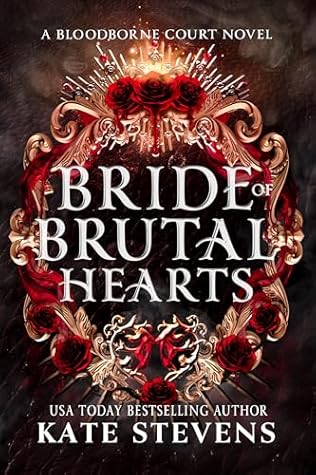
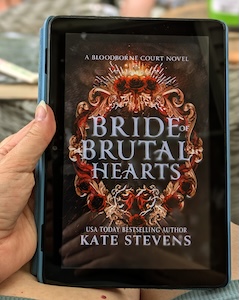
Two vicious kings. One captive bride. Their magic should have destroyed me.
Instead, it made them mine.
When my sister’s name is called for the vampires’ harvest, I step forward. It’s a death sentence, but she has a family, a future. All I have is a dusty bookshop, an ailing body, and a fate that always ends in fangs.
As the only volunteer, I’m claimed as the newest Mortal Bride—a living sacrifice to their two wicked kings.
The Conqueror, ruthless and imposing, his icy demeanor concealing his fiery intensity.
The Butcher, charming and capricious, his divine beauty disguising his cruel desires.
The kings intend to drain my lifeforce to fuel the spell securing their reign. But when the ceremony goes awry, we’re all ensnared in an obsessive bond… one not even death can break.
The Conqueror and the Butcher now hunger for more than my blood. They want all of me, forever.
I should resist them. I should hate them. They are the monsters who devour my people.
But no matter how brutal their hearts, I crave them just as fiercely.
I enjoyed this. At almost 800 pages to tell a fairly straightforward story, it’s far too long (and then ends on a cliffhanger to boot), and I have a few complaints. But overall, I enjoyed this. I liked Jules’ evil golden retriever routine, the dark and brooding Luc, and their relationship with each other. Nessa is pleasantly plump and has a backbone, though she isn’t really able to utilize it here. I’m hoping future books will allow her to grow in ways that allow her to find some agency for her internal fortitude. I appreciated the diversity and representation of endometriosis.
Here’s my main complaint. Stevens sets up a whole soulbond, fated mates kind of scenario that is supposed to bind people together. Each takes half the other’s soul. Or, in this case, the three share thirds. That makes them equal within the bond. Now, obviously, this is dark romance, and I’m not complaining about the dark themes. Nessa isn’t socially equal. Outside of the soulbond, she would have been a slave. (This is very much a master/slave dynamic.) She’s physically smaller. So, she’ll never be an equal in strength. She’s new to the whole scenario, while the men have been companions for 500 years. She’s not an equal there either. All par for a dark romance course. However, the soulbond is supposed to bind them as equals within the bond, and it doesn’t. The individuals might not yet have it in them to treat each other as equals, but the internal demands of the bond should be balanced. Nothing about what the bond seems to make Nessa want and do is balanced between her and the men, and, according to the lore Stevens created, it should have been. Plus, I was so sick of them not trusting anything she said when they are supposed to be in her thoughts.
Despite that. I’ll be looking for book two when it comes out.