Category Archives: personal

please keep digital box set covers this

Please put flat covers on digital box sets, a reader’s request.

Yesterday, I fell and twisted my ankle…or twisted my ankle and fell. So, I spent most of the day laid up on the couch with an ice pack, listening to an audio book (Aurora’s End) and tending my Calibre library, which is where I keep track of my non-Kindle books. (I really wish Amazon hadn’t changed file formats to prohibit being uploaded to Calbre. That way I could have them all in one place. But that’s beside the point.) Yesterday, I made sure every book had a listed page length and, if it was part of a series, that series was listed, along with the books place in the series.
look complete we are

This is something I’ve wanted to do for a long time, but didn’t want to dedicate several tedious hours to. In this case, I was stuck on the couch anyhow. So, I was glad for a task that was mindless enough to do while following an audio book. And I feel super accomplished!

I’m likely to spend much of today similarly immobile. This morning I’m looking at covers. And I’ve come to the conclusion that I have definite opinions about such things. I realize, of course, that my opinion is just that. I don’t expect to suddenly get my own way in all things, even this small thing. But, as I have little else to do at the moment (and in case it make any difference to hear a reader’s opinion), I’m going to tell you about it.

I want to talk about the covers of box sets/anthologies/omnibuses/etc. (I’m going to use the term box set to include all of these.) Well, as an aside I also want to take a moment to yell at the top of my lungs ALWAYS PUBLISH A BOOK’S PAGE LENGTH! I don’t care if it’s a digital book. It annoys the ever living FUCK out of me to try and discover if I’m picking up a short story or an epic and only find “File size: 3031 KB.” But that isn’t what today’s post is about. Today is about book cover conventions for box sets.

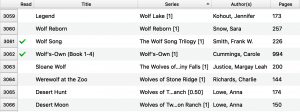
I find that a lot of authors use 3D rendering of the books in the set instead of a flat cover. I 100% hate this. I don’t actually hate the renderings. I think they’re pretty and make great promo tools. But they are pictures of a box set, not a cover of a box set. (See the difference?) Let me show you why I feel the way I feel. Here’s an image from my Calibre library (ordered by length). I could have done the same in Goodreads, but, as I said, I’m working in Calibre.
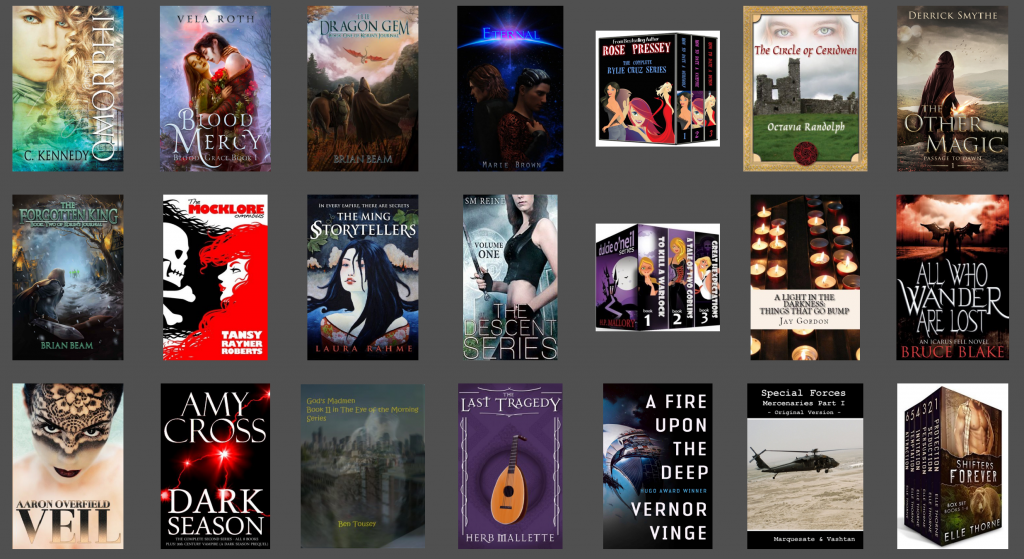
3d renderings of box sets don't fit in

You see, everything matches in size and shape. There’s a flow and then, BAM you hit those box sets. They’re the wrong shape, all that white space stands out, and they break up the symmetry. They basically stand out for all the wrong reasons. This annoys me more than is probably reasonable, but enough that I’m taking the time to write a whole post about it.

I actually feel the same way about authors who don’t stick to the size and shape conventions for book covers in general too.

make your cover match industry standard
That book in the middle isn’t an audio book. It’s just a book with the wrong shaped cover and it stands out horrendously. To me, books that don’t conform to the industry convention for cover shape scream ‘poorly done self-publishing.’ I actually hate to say anyone has done something wrong, because part of the joys of self-publishing is the ability to do things differently if you choose. But, for me, allowing readers to maintain ascetic cohesion when they are looking at their digital shelves is important. Again, it’s just my opinion. But it’s one I feel strongly about.

Going back to box sets. I don’t actually care If the cover is one created for the set and just lists the series name (like cover one), has stylized rendering of the books (cover 2), just has all the covers of the books themselves (cover 3), or something else entirely.
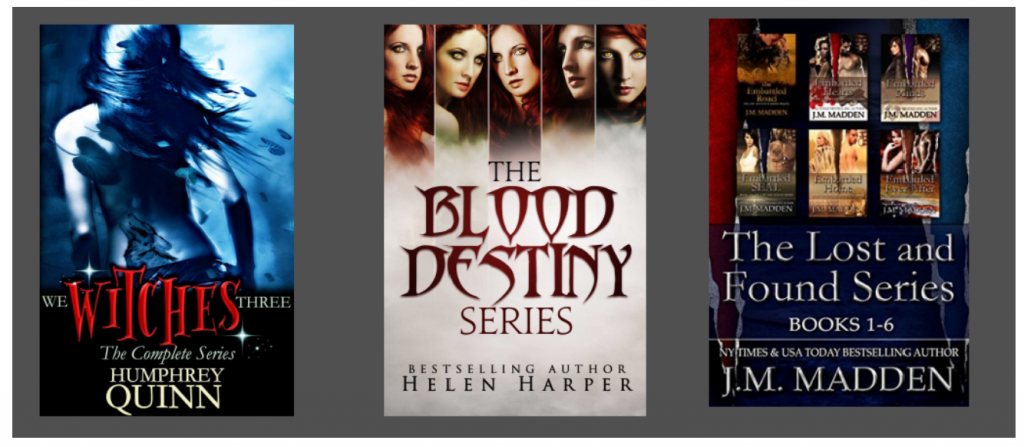
examples of box sets
Just so long as the overall image is rectangular and flat, so that it matches other books on my shelves.

And in case you needed one more reason to stick to flat covers, let me mention #Bookstagram. I love Instagram. I post a ton of book pictures. So many, in fact, that between See Sadie Read and Sadie’s Spotlight, I have two accounts full of almost nothing but books. (The latter entirely ebooks.) I recently posted this one.


Nowhere, absolutely nowhere (not on Amazon, the author’s page, or Goodreads) can I find a flat image of this book cover. And while this was an ARC, the book has been published with this as it’s cover. Tell me how much nicer that picture would have looked with a flat image of the cover! It’s got a super pretty cover. I’d have much preferred a real image of it.

So, there you have it folks, my unequivocal opinion on the size and shape of digital box sets. Am I alone in this? Anyone feel differently?
banner w Photo by Universal Eye on Unsplash copy

How do you read so fast?

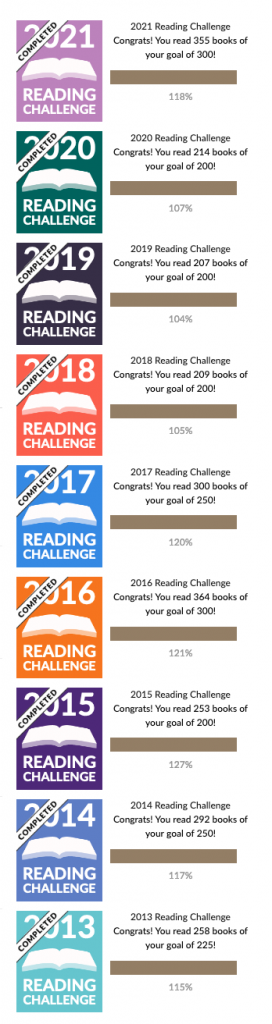
Do you ever have imaginary conversations with yourself? I found that I was doing that just now. I was explaining to myself how I can read 200-300+ books a year. As is so often the case, this came about completely randomly. I scrolled past this Instagram post:


View this post on Instagram


A post shared by Emma Hamm (@emmahammauthor)

And I thought, yep, there’s me the speed reader. But then I remembered passing this tweet a week or so earlier and thought, no that doesn’t really describe me:

Because I read fast, like really fast, but I can also tell you what color shirt Character A was wearing in chapter 11 and pick out underlying themes and tropes, etc. So, I’m obviously processing what I reading.

Someone on Goodreads once commented in a conversation “Wow, you’re a fast reader!” And then later complemented me with, “you assess the quality of books cogently and thoughtfully, and you have a very real, unaffected style of expressing yourself.”

goodreads challengesNow, I’ll preen under that praise in general (even if it was quite a while ago). But the point of including it here is the assessing the quality of books cogently and thoughtfully. I think I do that, but at a volume of 200-300 books a year. Admittedly, I don’t give every book an equally in-depth and deeply thought out review. But I am reading each book thoroughly enough to understand them on a fairly complete level and I do it very quickly.

The question I was pondering today was how. And I think I have an answer. Though I’m no neurologist (or whichever -ologist would specialize in this field), so what I think is happening in my brain may be way off base. And even if I’m right, there are probably far better, more accurate ways to describe it. But I’m going to try and describe it.

All credit where credit is due, my feet were put on this path by my husband. Earlier this year (maybe late last year, time has no meaning anymore) I was grumbling to myself and him. I’d been filling out an online form and done it wrong, which I do as often as not. And I said something  along the lines of, “I swear I didn’t used to be so bad at this. I have two Masters degrees for Christ’s sake. Surely I’m able to read a stupid form.” Very calmly, he said, “It’s because you don’t read.”

I blinked at him and went, “WTH, 300+ books a year says otherwise!” Now, I can’t remember every sentence that was exchanged, but the gist of what he said he’d observed me doing was that I don’t read a sentence by reading each word in that sentence (or instructions on a form). He was of the opinion that I read some of the words, maybe every third, and my brain simply fills in the rest—that I’m very good at extrapolating and filling in blanks. Predictably, I was incensed and responded, “I don’t do that!”

But as I paid attention over that next few days, I found that I kind of do do that. Maybe not that exactly, but some version of it. It explains why I can tell you what color shirt Character A is wearing in chapter 11, but 10 minutes after I finish a book I often can’t tell you the main character’s name. Because I don’t read “Sarah wore red.”  My brain just filled in my mental place holder of Sarah and red.” I’m not wholly visual. So, I’m not claiming to have a full cinematic picture in my head, but that my brain gleans the information without acknowledging the letters making up words. Does that make sense?

And this even kind of makes sense when I think about being a child learning to read. I had a very, very hard time learning to read. I got pulled out of normal class for remedial reading lessons at school, my grandma bought me Hooked on Phonics (anyone remember those), my mom worked with me everyday after school. I really really struggled to read. And this lasted long enough and I was old enough that I actually remember the visceral feeling of it all finally snapping into focus and understanding at last.

I call it my Helen Keller moment. Certainly, it’s not as dramatic as someone who was blind and deaf finally making a connection with words and meaning.

But it is a stark and true moment in my mind. In my imagination, something physically snapped into place and I understood something that hadn’t seconds before. And after it did, within the same school year, I was moved from the remedial lessons to the advanced.

When I discuss those early years with my mom, she laughs and says, “Lord, you were as dyslexic as the day is long.” Now, I don’t think there really is any such thing as “were dyslexic.” I’m fairly sure you either are or you aren’t and it’s a constant. I think what she’s getting at is that whatever normal pathway a child’s brain forms when learning to read, mine just couldn’t. There was an impediment of some sort. I imagine a road that normally follows a straight line, but in my case had to curve around a bolder. It took longer because it had to find and forge a new way. And because of that, the scenery is also a little different than other people’s. My ‘reading’ doesn’t work exactly like other people’s ‘reading.’ When my brain couldn’t make it work the ‘right’ way, it found an alternative way.

This is where an -ology would come in handy. I have no idea if that’s accurate. But it’s how I imagine it. And if the way my mind found was to read the parts of a sentence that make sense and fill the rest in (and to have gotten really good and accurate at it over time), well that makes sense to me too. As does being fast because it’s not reading/processing each individual word. And predictably, it works a lot better with fiction than forms.

None of this is something I do purposefully. It’s just how I read. I don’t know any other way to do it. I literally don’t know how to slow down.

So, there’s my totally random, possibly ill-conceived rambling post for today. Enjoy.

jo linsdell blogger interview banner

Hey look, I got interviewed

jo linsdell interview


About a week and a half ago, I was interviewed over on Jo Linsdell Books & Blogging about my experience as a book blogger. It was a lot of fun. I shared it around on social media, but didn’t even think to share it here. Sorry.

If you’re interested in what I might have said you can go check it out here. If you’re interested in what some of the other book bloggers/tubers/tikers/stagramers said, go here or here. Either way, enjoy.