Tag Archives: book review

arctic chill

Book Review of Arctic Chill, by Arnaldur Indriðason

I borrowed a copy of Arnaldur Indriðason‘s Arctic Chill from the Little Free Library. I was completely thrilled to see a book by an author whose name started with the letter I. I do an alphabet challenge every year and an ‘I’ author is one of the hardest to come up with.
Description from Goodreads:

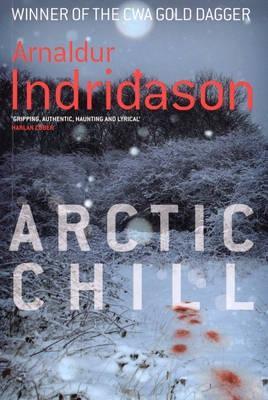
The Reykjavik police are called on an icy January day to a garden where a body has been found: a young, dark-skinned boy is frozen to the ground in a pool of his own blood. Erlendur and his team embark on their investigation and soon unearth tensions simmering beneath the surface of Iceland’s outwardly liberal, multicultural society.

In this new extraordinary thriller from Gold Dagger Award winner Arnaldur Indridason, the Reykjavik police are called on an icy January day to a garden where a body has been found: a young, dark-skinned boy is frozen to the ground in a pool of his own blood. Erlendur and his team embark on their investigation and soon unearth tensions simmering beneath the surface of Iceland’s outwardly liberal, multicultural society. Meanwhile, the boy’s murder forces Erlendur to confront the tragedy in his own past. Soon, facts are emerging from the snow-filled darkness that are more chilling even than the Arctic night.

Review:

I thought this was interesting in some respects and a little dull in others. Being a book translated from Icelandic, reading the culture from an insider perspective was a treat. So was the atmosphere of the book, all bleak and cold like the environment. Similarly, I felt like (as an American reading an Icelandic book) this isn’t a book an American could write. Certainly we, as a people, struggle with some of the same issues brought up in the book. The immigration arguments could have shown up on any right-wing media outlet here, for example. But the fact that the investigation so quickly and strongly focused on the child’s race would never have passed muster in American fiction, I think. It addresses racism too starkly. Again, interesting.

But at the same time, the vast majority of this book is the detectives going around and asking various people the same questions and getting largely the same answers. It was slow going until a sudden break led to solving the case at the end. All in all, I’d read another Inspector Erlendur book, but I’m not rushing out to do it.

Book Review of The Wounded Ones, by G. D. Penman

I received an e-copy of The Wounded Ones (Witch of Empire #2) by G.D. Penman through Netgalley. You can find my review of The Year of the Knife, book one of this series, here.

Description from Goodreads:

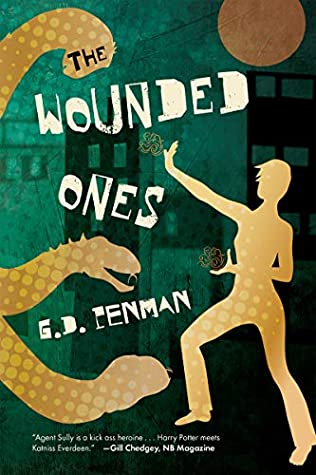
Demons and serial killers are Iona “Sully” Sullivan’s bread and butter, but nothing could have prepared her to face off against the full weight of the British Empire at the height of its power. With the War for American Independence in full swing, she finds even her prodigious talents pushed beyond their limits when citizens of the American Colonies begin vanishing amidst rumours of crop circles, hydra sightings and worse.

Through a wild and lethal adventure that will see her clashing with the Empire around the world and beyond, the only constants in Sully’s life are an undead girlfriend, a giant demon crow that seems to be trying to court her, regular assassination attempts by enemies on all sides and the cold certainty that nothing and nobody is going to make it out of this war in one piece.

Review:

It took me a while to get into this book, which worried me a little. It’s been a while since I read book one, but I remembered liking it. So, I worried I was going to be disappointed when I didn’t immediately love this one. But I stuck with it and it paid off.

Once the action starts rollicking along it doesn’t stop. Mostly though, I love Sully. She’s just the sort of sarcastic, kick-ass broad I like to read about. I did think all the fighting got a little tedious and she does have a pretty serious case of unkillable. It reduces the tension of a book somewhat, knowing she’ll suicidally throw herself into danger but miraculously survive every time (often without any apparent emotional scarring). I also thought Marie was reduced to a mere plot device here, which was a shame.

Overall, however, I enjoyed this and look forward to more. And there must be more because this one ended with a pretty big loose end.

Genex of Halcyon

Book Review of Genex of Halcyon, by Joshua Stelling

I received a copy of Genex of Halcyon (by Joshua Stelling) from the author, for the purposes of a review.

Description from Goodreads:

In this near-future utopia, in Halcyon all are free. People with wings fly alongside skyline railcars, between the towers. They are more than what we’ve known as human, the next stage of our evolution. Amid the psychic computers and genetic freaks, competitive laser sports and mindless bots, runs a love triangle stronger than death itself. Over these three nights in 2051, Harmony and Azad must find their way through misfits and prophets, blood and tears, to new horizons. Their fate, in the time of climate change, in the afterglow of the rise of machines, is entwined with the world.

Review:

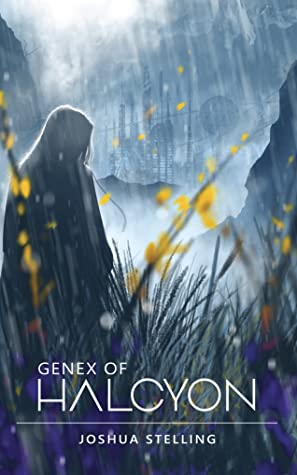
I went into this with really high hopes. The cover is gorgeous and the obvious work that went into it carries on into the inside—nice paper, pleasant font, good enough editing. The physical book is slick.

Unfortunately, about a dozen pages in I said to my husband, “I think this author wants to be a poet, instead of a novelist.” (I was therefore not surprised to find a selection of Stelling’s poetry at the end of the book.) By page twenty, I wanted to be done and not have to read anymore. Because here’s the thing. I don’t care how pretty or lyrical writing is, what works in a page-long poem is unbearably pretentious and damn near unreadable over 212.

I spent most of this book confused and, since it’s written more like a series of interconnected vignettes than a flowing plot, I was wholly uninvested in the characters. Then, the entire thing ended in tragedy. Of course, it did. Because an author who thinks his pseudo-cyber-mystic ramblings practically in stanzas, using a teen girl’s sexuality as the harbinger of doom, as men go around and tell women things and women raptly listen, would think the only acceptable, intellectual enough ending would be a meaningless tragedy. Of course. I think there might have been an interesting world here, but frankly, I couldn’t find it in the actual writing.