How do you handle writing reviews of books you didn’t like that are outside of your normal reading genres? This is a quandary I’ve found myself in more often since opening myself up to review requests. I get requests from all genres and try to read a little of everything. I also choose a lot of books from Amazon’s KDP and make a concerted effort to not let myself fall into only downloading one type of book. Though by and large I download a lot more PNR than anything else.
This, however, is a prime example of why I try to force my horizons open. Until about this time last year I didn’t read romance of any sort, paranormal or otherwise. Now it’s one of my favourite genres. I’ve gotten older. My tastes have changed. Maybe I’m a little more of a cougar than I used to be, I don’t know. At some point, though, I had to branch out and give that first PNR a chance.
The honest truth, however, is this doesn’t always work. I’m not going to like everything I try, but does that mean I shouldn’t be allowed to then write a review stating that I didn’t like the book? To clarify the question, does the fact that I’ve historically not liked the genre somehow negate my actual dislike of a book or social permission to express that opinion? What is a book review, after all, but my own personal opinion of what I’ve just read? I’ve never promised anyone an impartial review and don’t even know that it’s really possible to write one.
I recently posted the following review on Amazon, along with a 3 star rating. It is what prompted this particular exercise in crystallising my own opinion through public discourse. I’ve purposely removed any reference to the actual book. The intention here is not to IN ANYWAY disparage the author or her book. It is simply the impetus of the discussion.
I’m not claiming any real anonymity though. It wouldn’t be difficult to scroll through my Amazon reviews and find the one, but the book isn’t the point of this post. What is and isn’t considered acceptable by the review reading public is. Please understand that. This also isn’t a disguised attempt to defend myself against a perceived attack or to have a go at the commenter quoted below. I don’t want to get mired in any ill-conceived author/reviewer behaving badly quagmire.
The review:
Oh God, I wish I hadn’t read that. I don’t know why I did it to myself. I know I don’t like this kind of story. I do. But I was tempted by the sarcastic tone of the description, which I admit runs through out the story and is just as funny. Honestly, I’m not even saying it’s not a good book and everything that women who like mushy love stories and frail, save me from myself heroins appreciate about the genre. I’m just not one of those women.At 27% through the book I posted this status update here on Goodreads,
I’m ~25% in and I know things are going to change, but as of this moment I’ve decided that a more satisfying rewrite of this story would be: Julia was having a bad day, week, month year. Stranded on the side of the road with a flat tire she doesn’t know how to change, Joe stops to help. She is then such a bitch to him that he gets back in his van, drives away and leaves her there like she deserves. Seriously!
The problem is that it didn’t change. Julia remained a completely bi-polar, possibly psychotic witch who did NOTHING to deserve Joe—who was of course wonderful in every tall, blond, muscled, 8-inch, committed, loving way.
To top it all off I don’t get the who lied about being a cop theme that the plot hinges on. First off, so what? He a cop, big deal. Second, he DID TELL HER he’s the chief police. The fact that she didn’t believe him doesn’t negate the fact that he told her. Plus, even if he hadn’t told her he told her enough of what he does for a simpleton to figure it out. It’s not his fault if she’s just too stupid to read the large, neon, flashing, heroic sign he paints for her.
Wylde’s writing is perfectly readable and, like I said, it is funny. But This was definitely not a good match for me. |
Within a day two people had marked it as unhelpful and one person commented, “This is the worst review that I have ever read. If you don’t the genre DO NOT BUY THE BOOK!!! Unnecessarily harsh and mean spirited.”
The commenter’s instruction to not buy a book in a genre I don’t like is my point of primary interest here. Am I not allowed to negatively review a book I disliked simply because I admit that I’m not a fan of the genre in general? I’m not a huge fan of contemporary, depression era fiction either but I recently wrote a positive 4 star review of Sandra Brown’s Rainwater.
Now I understand the commenters point. She appears to feel that I’ve punished the book for not being in a genre I like. Something that is obviously not the book’s fault. I’ll also concede that this was a more vitriolic review than I normally write and I have, hence, rewritten parts of it to try and pull it back a little bit. But I’d also point out that I gave the book 3 stars, and in an attempt to be balanced stated that it is funny and the writing is good. I also feel that the points I made about not liking the female character and not understanding the police officer angle are still valid ones. They would be the same even if found in a book from a genre I claim to love. But what are my…well, I don’t want to call them rights as a reviewer, because that would be too weighty a word, but I don’t currently have a better one? So we’ll go with that.
I am, myself, an intrepid author. I understand how important reviews are, good and bad. No one pays attention to a book until it has a few good reviews and a lot of people don’t take your reviews seriously until you have one or two bad ones. As such, I review EVERY BOOK I read. This leaves me in the predicament I found myself in while writing the above review. I could either a) lie and say I liked it when I didn’t, b) write a vague, uninformative review that gave no real information, c) write an honest opinionated review, or d) not write a review at all.
I suspect a lot of people would tell me to go with option D, since ‘if you don’t have anything nice to say don’t say anything at all’ is a fairly common mantra on the indie book circuit. It’s also one I have been fairly vocal about disagreeing with. A reviewer’s reviews are worthless if all filled with nothing but praise IMO. This, however, is a debate that could easily fill a post or two of its own and I’ll not let myself be distracted. Let me just say that option D wasn’t an option for me. As stated, I review everything I read. To skip over this one would be according it special treatment that I had not reason to offer.
While not uncommon in practice, I doubt anyone would really advise me to take up option A or B either. That left me with option C, an honest and admittedly opinionated review. But what to include? I strongly suspect the, “I know I don’t like this kind of story” portion is the where the trouble arose. I, however, see a place for it there. I choose whose reviews to give most credence to by which reviewer seems to be the most like me. Like many people I have certain reviewers I pay special attention to because history has proven we like and dislike similar things. So informing the review reader which type of book reader I am helps inform them whether or not we might have similar tastes.
That’s my defence for having initially included it. However, like I pointed out, I’ve taken it out. I think it probably prevented review readers from clearly seeing the rest of the review. They may have seen it and immediately assumed everything after it was biased. I can even understand that thought process. It does however ignore the fact that, unless I’m being accused of reading the book just to write a means spirited review of it, which I don’t think I am, something about the book attracted me to reading it in the first place. In this case the sarcastic narrative style.
So the question I’m ending with, the small token of information I’m hoping to garner from you the reader is, am I right? Should I openly and honestly be able to say I generally don’t like this type of story, while also being able to separately declare myself to have liked or disliked this particular story or is that just being naive? Will the former always eclipse the latter? If that’s the case, how would you advise I handle such situations in the future. I see no one complaining about reviews that start out ‘I don’t usually like genre X, but loved this particular book.’ In this case the general dislike of Genre X only serves to heighten the importance of liking the book in question. It obviously doesn’t work in reverse.
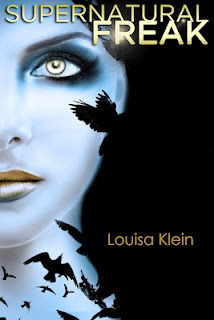 I grabbed Louisa Klein‘s Supernatural Freak from the Amazon KDP list.