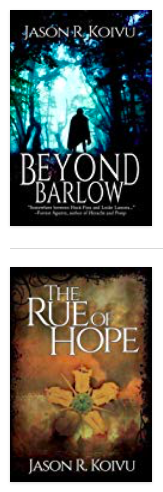
I received a copy of Beyond Barlow and The Rue of Hope from the author, Jason R. Koivu. I write each review as I finish the book. So they stand alone but don’t necessarily flow one into the other.
Description of Beyond Barlow:
Ford Barlow is banished from his home and the clansmen he loves after a tragic accident forces him into joining a band of thieving boys. Adventure and fun abound and it seems Ford has found a perfectly fine new home until a mysterious massacre chases the boys away from their beloved woodland hideaway, through a magical and dangerous forest, and into the arms of conniving bandits. These vicious men push Ford to the brink of his moral limits in Beyond Barlow.
Review:
Technically, I didn’t agree to review this book. I accepted The Rue of Hope and Koivu was kind enough to send Beyond Barlow along too, so that I could start the series at the beginning. I mention this because I’m pretty much done with Young Adult novels, avoiding the genre when I can. While Beyond Barlow is about a young adult, I wouldn’t necessarily call it a YA book. Despite that, I didn’t go into it excited to read about a 15ish-year-old boy. But I wanted to start at the beginning.
The book is well enough written and it’s not a bad book. However, I took a long time to read it because I kept avoiding it. It’s just unremitting mishap and misery from start to finish, and you feel very early that that is going to be the case. I found nothing in the story to enjoy or look forward to.
While Ford isn’t a bad guy, he’s not all that bright and despite often trying to do the right thing, I found him a little sociopathic at times. He wasn’t a character I could relate to. Similarly, all the side characters are grey at best, most villainous and with a tendency to suddenly disappear or die. Add to this the fact that all the events of the book are sad or anger-inducing or simply unpleasant and the reader is left with nothing to look forward to. One unsavory character said on page 239, “A man needs a bit of fun, and all we’ve had is shit and misery.” And that’s exactly how I felt about reading this book.
Again, it’s not badly written. It’s not a bad book. Some people enjoy such things. I’m just not one of them. All in all, I didn’t hate it so much that I won’t read the next book. But I didn’t enjoy it enough to look forward to it either. Especially since with a title like The Rue of Hope, I can’t really expect any more lightheartedness out of it either.
Description of The Rue of Hope:
Murder in the streets. Murder in the houses of the holy. The violent deaths of prominent figures have the populous on edge. Now, amid fire and flood, the revolt is on. The castle is taken, the lord is on the run, and the city is crumbling. With society on the verge of collapse, impulsive street-fighter Ford Barlow finds himself in just as much turmoil. Not only is he juggling his own problems, but his slippery rogue friend is embroiled in a string of high-profile assassinations. Mercenary work for a mage meant to distance him from his troubles only highlights his selfish ways and drives him back into a crumbling world of scandal and betrayal. Magic, adventure and murder combine in this fantasy-mystery!
Review:
I felt much about this second book as I did the first, there is very little to enjoy in it. Everything is death and despair. But here, more than in Beyond Barlow, I really feel the description (while not inaccurate) is deceptive. All of those events happen, but in such a background capacity as to be almost irrelevant. Ford isn’t integral to any of them. He’s not even aware of most of them. In fact, he has very little volition in the whole book. In my head, I repeatedly thought of this story (series really) as a list of woes that befall Ford, and not as any sort of adventure Ford embarks on, or battle he chooses to fight, or purpose he finds for himself (the things that structure a plot). As such, I felt very much like there wasn’t so much an actual plot as this text was simply the documenting of a certain segment of Ford’s life. Two years earlier or later would and could have read the same. I felt no building toward any climax. Thus, I found it excruciatingly unsatisfying.
Having said that, it’s not badly written and I have complained recently about being tired of reading about the same sort of anti-hero over and over again. I can’t accuse Koivu of that. Ford is an anti-hero, for sure, but not one you see every day. He’s not overly bright (or at least not a deep thinker), he’s built like a brick shithouse, he’s morally ambiguous, and while he often tries to do the right thing, he usually fails. Some of what he does in this book makes me dislike him in the extreme. (Trying to steal bread from a starving child, drunkenly manhandling a woman when she rejects him, hanging out in an alley to creepily watching a young woman through her window, being drunk for a full third of the book, what he does to Addy even knowing she’s fragile, what he does to Elle in an attempt to save her from his imagination.) But he does value protecting the weak, which redeems him a little. If he had been a man with more prospects, he probably could have been a better man. (Which I do think is some of what Koivu was trying to get at.)
Speaking of the author, Koivu himself has a few ‘men writing women’ moments. He sexualizes a 12-year-old girl at one point and almost all of the women who actually speak are prostitutes or in love with/trying to sleep with Ford in some capacity. This seems so avoidable. Why place a child in a sexual position? It didn’t progress the plot any or add anything to the story. Similarly, why include the random gay-bashing scene? Especially if Dunn, the primary perpetrator involved, was never going to appear again? I can kind of see it maybe lets the reader see that there are lines Ford won’t cross (or even understand the appeal of). But I think that was already established, so mostly I thought it added nothing of value.
All in all, I didn’t actually think this was a bad book. I just think it wasn’t really for me.
Edit: The author politely emailed me to address why the gay-bashing scene was included. I won’t repeat it since it would be a spoiler. But he does give a considered reason. I think there might have been a million other ways to accomplish what the scene did, but I acknowledge that Koivu did have a reason beyond titillation, which is what I took it for (not homophobia).