I started a little bit of a poetry (and such) challenge almost by accident. I promised myself that I would be better about reading down my overflowing bookshelves of physical books this year. As a first wave, I went through and pulled several slim volumes that I thought I could read quickly. The first turned out to be poetry (and a few microfiction story collections), which led me to ask, `Oh, how many other such books do I have?’
I found several, enough to build a reading challenge around them. So, that’s what I did: I built a mini reading challenge around poetry, micro-lit, and other slim volumes of artsy or uncategorizable reads (things I probably wouldn’t give a whole post to, but still want to document). This included several poetry volumes, 3 humorous parenting books, a few books with short stories, some essays, some sarcastic philosophy, and a love letter to literature in the form of a memoir.
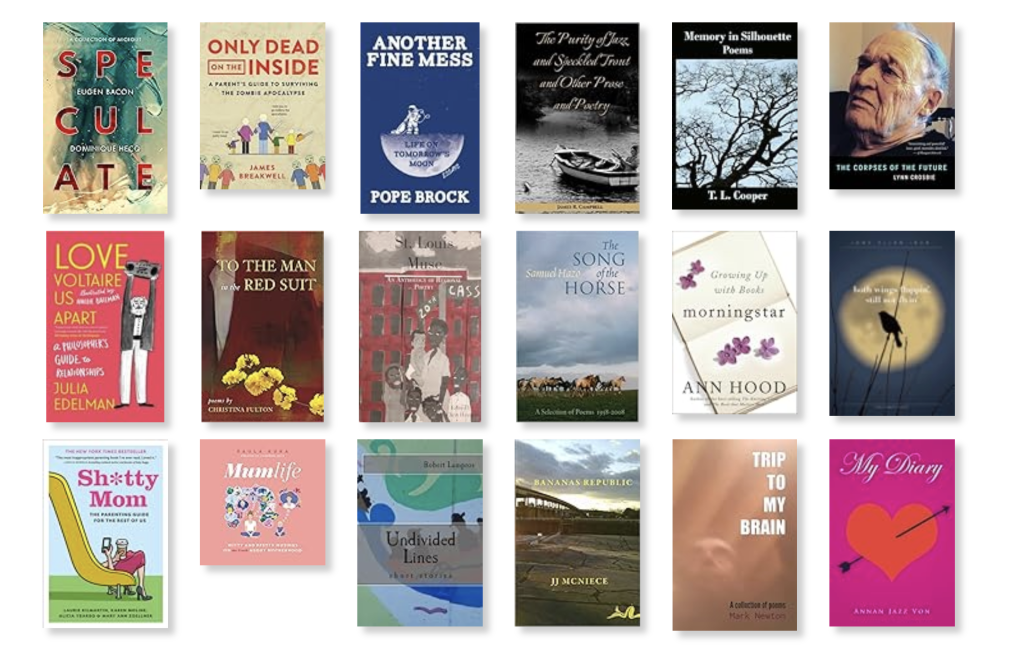
Up there are the books, and down here are brief reviews:
Primarily Poetry:
Life in the Slow Lane, by Ruth Anderson
I picked up this little book of poems in a local little free library. The author was (at the time, it’s from the 90s) 83, living in one of the local assisted living facilities in town, and selling these herself. I can’t even find it on Goodreads. It was a true indie endeavor.
As I said above, I’ve been trying to read-down the poetry books on my shelves. So, I’ve read several books of verse lately, some more experimental than others. I appreciate Anderson’s poetry because it is very straightforward but also lively, with an occasional cozy everyday element. I even texted one of them to my daughter because I thought it described her own situation well, and she’d get a chuckle from it. I think this was my favorite of this whole batch of poetry books (and I can’t even review it on GR to let people know 😂.)
The Purity of Jazz & Speckled Trout & Other Prose & Poetry, by James R. Campbell
This was OK. I suppose it all comes down to preferences. Campbell has a surprisingly different voice in his poetry and prose. I felt little for the poetry, liking some more than others. And while I can appreciate the competency of the short stories, none of them resonated much with me. I think Campbell tends toward rural noir (yes, I made that term up), where everyone is bad in some fashion, and no one gets a happy ending. Meh, it feels pedestrian. But I also suspect these are just stories by a man, about and for other men, and as a woman, there isn’t a lot in them to hook me. I will say that the author isn’t guilty of booby-boobily, though, which is a pleasant surprise.
Memory in Silhouette, by T.L. Cooper
I claim no expertise in poetry. I judge it entirely on whether I like it or not. So, take anything I say with a grain of salt. Some of Cooper’s poems I liked, some I didn’t. But the vast majority of them I had no opinion on because they made no impact on me, which leaves me thinking they’re rather mundane. The book definitely has a discernible and satisfying order to the poems, though. I felt I’d been on a bit of a journey with the author. I hope she gets (or got) that second, second, second chance.
The Corpses of the Future, by Lynn Crosbie
Fucking heartbreaking; not necessarily any individual poem. Honestly, on its own, absent the context of the whole, I’m not sure that any individual one makes a lot of sense (to me, anyway). But altogether, this collection broke my heart in a million ways.
Stories and Poems of a Class Struggle, by Roque Dalton
I didn’t know I was into political poetry, but I liked these a lot, especially those written under the pseudonym Jorge Cruz. I appreciated the bibliographic information about Dalton beforehand, too.
To the Man in the Red Suit, by Christina Fulton
A little bit dark, a little bit absurd. This feels like Fulton’s homage to her dead father…or to her father’s suicide. I liked some of them; didn’t get many of them.
The Song of the Horse, by Samuel Hazo
Meh, I’m sure these poems are technically fine. I just didn’t particularly connect with most of them…and not just because of Hazo’s tendency to boobs boobied boobily, which he seems to do when discussing every non-familial woman in the book.
He says in one (Thus Spoke Mercutio),
Let us
have poetry that strikes us dumb
or leaves us stabbed so deeply
that the wound in perpetuity stays raw.
Let us have that or nothing
Put simply, I did not find this here. Of those, I came closest; it was the soldiering poems I liked most. So, though Hazo seems to have the mechanics of poetry down—and I’m sure there are some who will relate to and love these poems—I read them but felt little in response.
Both Wings Flappin’, Still Not Flyin’, by Jane Ellen Ibur
I’m convinced this is what love looks like: all-consuming, devastating, and difficult. But also the stuff that fills one’s own cup and makes days worth living. Ibur’s story, never wholly told but hinted at so completely that it’s known, broke my heart. I felt her love for Mary and her prolonged grief at her loss.
Undivided Lines, by Robert Lampros
This is a local-to-me author, and I always love to support local authors. I did, however, initially miss the fact that this is Christian fiction—a disappointment for sure. However, I’m pleased to report it wasn’t overpowering for most of the stories. (One or two got a little heavy-handed in the religion department, but most didn’t.) I generally thought this was a refreshing little collection of relatively short stories.
Bananas Republic, by J.J. McNiece
I won this copy of Banana Republic somewhere, probably Goodreads or LibraryThing. On reading it, I got a few chuckles. I appreciated what I think some of the political commentary was aiming for. I liked the poem Delta Culture (I think because it’s structurally more familiar than most of the book). But, honestly, I just didn’t get a lot of it.
St. Louis Muse: An Anthology of Regional Poetry, by Chris Hayden (ed)
I’m pretty sure I picked this up from a local Little Free Library (or book exchange shelf in a cafe) because I’m always intrigued to explore local aspects of my own (adoptive) city. I enjoyed these poems about a St. Louis not my own. I don’t mean one I don’t claim, just one that I don’t have the invitation to embody. This means that there were aspects to some of what was written about for which I have no reference (either because it’s of the past—the book is 20+ years old and many poems reached farther back—or my own experiential ignorance). In such cases, letting the rhythm and meter flow over me was the most I could appreciate. Others I felt deeply. I’m pleased by the happy little accident this collection turned out to be.
Trip to My Brain: A collection of poems, by Mark Newton
I want to preface my review of this collection by talking about how I came to have it. The author emailed me and asked me to review it. I was annoyed, as I often am. My policies say I am open to offers of femme-authored monster romance. I also wrote a whole blog post, which is linked, saying I’m not interested in books by men anymore. And still, here was a man asking me to read his poetry book. So, either he didn’t bother to read my policies (the audacity to ask for my free labor and not be willing to do even that much), or he read them and decided he was some gilded exception and made a claim on my time anyway (again, the audacity). I don’t recall that I even bothered to respond to his email. Why should I give him more of my time than it took to read his if he can’t be bothered to respect that time in the first place?
But damn, my somewhat obsessive nature that doesn’t allow me to delete books easily. I dropped the collection in my Calibre just because it felt wrong to throw it away. And here, a mere few months later, I read it, basically confirming the functionality of Newton’s rude behavior. Despite all of this, I read it with an open mind. Separation of artists and art and all that jazz.
Here is the review: This is a collection of (mostly) rather long poems. They largely cover what you would expect from a socially/politically/environmentally conscious father in his early fifties. (Unless Newton is not a socially/politically/environmentally conscious father in his early fifties. In which case, bravo, congratulations to Newton on successfully stepping empathetically into the role. That would take this collection from mundane to something more interesting.)
I do not mean to say these poems are bad (IMO, I claim no expertise); they are just somewhat pedestrian. Having said that, I enjoyed them for the most part. I read this directly after a poetry collection that was quite…experimental(?) in its form and function, and I very much appreciated that Newton’s poetry is in recognizable, familiar meter (Or familiar to this Western reader), and I generally understood their intent.
My favorites were Murphy’s Eulogy and XXIV, which is a love letter to literature, I think. I liked these best because they were the ‘something different’ in the collection. My least favorite was Orgasmic Interlude With a Guitar. (I’ve made up these names, BTW. As the poems are numbered and ordered by date—no titles.) The verse wasn’t bad. But the subject was so clichéd as to make me cringe.
All in all, I would not consign this to the literary dustbin, but your love or disdain for it will likely come down to what you do or don’t like (i.e., personal taste). Give it a go.
My Diary, by Annan Jazz Von
I struggled with this collection. I suspect many of these are actually written to be songs. Several words are written phonetically, others with vowels elongated to stretch the word over syllables, there are tails (or in one case, a ‘tial’) that I think are chorus-like refrains, and there are superscript notations, such as x3*. The problem is that nothing in the book actually tells you if they are songs or not, and without clarification, how does one read “U one and true-oo-oox4, true-oo-oo-oox3, tru-oox2, trux2-oox3-ly, y.”? Am I tooting like a train? If so, why repeat the OOs before telling me to repeat them further? Am I saying “x3”? I don’t know. And there was this (or similar) sort of question in almost every poem.
There is a hopefulness to the collection, though, and the About The Author suggests that the author was roughly 19 when this was published. I suspect a lot of these might have been written when they were even younger. I think there is talent, but either a poetry collection is the wrong publishing format (it’s entirely possible the notation style is completely normal in another literary field), or the author needs to learn a bit more about poetry conventions—at least enough to tell the reader how to read the work if need be. (I don’t claim to be an expert myself, but I feel like that’s a safe assertion. If you’re going to do something unusual, you need to give your reader some guidance on how to follow.)
All in all, I’m just going to go with saying I wasn’t really able to engage with the meter of a lot of these poems (some I couldn’t even find), but I appreciate some of the subject matter.
Primarily Prose:
Sacrastic Parenting Books (the only type I’m ever attracted to):
Sh*tty Mom: The Parenting Guide for the Rest of Us, by Laurie Kilmartin, Karen Moline, Alicia Ybarbo, & Mary Ann Zoellner
Meh. I mean, I see the humor in it, obviously, but the whole thing is just kind of pedestrian.
Only Dead on the Inside: A Parent’s Guide to Surviving the Zombie Apocalypse, by James Breakwell
Irreverent and humorous, just as promised. But the joke got stale before I reached the end.
Mumlife: Witty & Pretty Musings on (the Truth about) Motherhood, by Paula Kuka
This was a cute little depiction of what it is like to be a new mom, minus the mystical myth of motherhood that tells us all that it is the only thing that could ever fulfill us (and it is all we need to be fulfilled). It’s still a fairly sanitized version of Hot Mess Mom, and “I love my kids more than anything” is still the theme. So, it’s not that far removed, but it is far enough to make it appreciable.
Stories/Essays
Speculate: A Collection of Microlit, by Eugen Bacon & Dominique Hecq
Prose poetry is new to me. I think I like the idea more than the reality. Or maybe a whole book of it is just too much, even if I broke it into snippets and read it over weeks. I liked some of these call-and-response pairings more than others, and I just didn’t get quite a lot of them. All in all, I’m glad to have tried something new. But it’s no new favorite or anything.
Love Voltaire Us Apart: A Philosopher’s Guide to Relationships, by Julia Edelman
I won this somewhere along the way, though I don’t now remember where. I’m sure it’s very witty (and pithy). But having not actually studied philosophy, I’m afraid most of it just went over my head. I tried, though.
Morningstar: Growing Up with Books, by Ann Hood
Meh, it’s a love letter to literature, that’s for sure, and I can appreciate that. But the whole thing has a strong sense of re-remembering to it. I’m sure the books Hood discusses were meaningful to her in her youth. But she describes the importance of books to her 6-year-old self in terms and with the depth of adult understanding. By the time I reached the end, it all felt artificial, gimmicky, and pretentious.
Another Fine Mess, Pope Brock
I read this, one essay a day over a week and a half, and enjoyed it more than expected. It works well as a book you take small bites of.
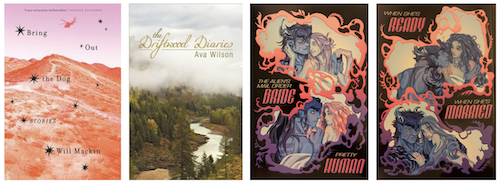
Some late add-ons
Bring Out the Dog: Stories, by Will Mackin
This was a surprise winner for me. Not because I expected it to be bad. I wouldn’t have read it at all if I expected that. But because military affairs hold so little interest for me (and this is clearly written for those for whom they do). However, this one ended up on my TBR almost by accident, so I gave it a try and found that I liked the stories. Granted, no one, not even our ‘good guys,’ comes off looking like heroes, and one definitely gets the sense that morals are more flexible than preferable. But well worth the read.
The Driftwood Diaries, by Ava Wilson
These were sweet little stories. A bit amateurish, perhaps, and I found the diary entry format to be tedious, yet effective. I do not regret reading it, even if I have no memory of how it ended up on my bookshelf.
Risdaverse collection (#0.5, .75, 1 & 2), by Ruby Dixon
This particular collection was a Renegade Romance special edition that bundled the shorts in one volume. I wrote individual reviews for these stories on Goodreads, but collectively, I thought they were merely OK. One I disliked; the rest I found entertaining but fairly bland, trope-heavy, and overly reliant on telling the reader about things that happened off-page in undocumented passages of time.