
Category Archives: book review

Tallulah's got a shopping trolley

Book Review of C.L. McRitchie’s Tallulah’s Got A Shopping Trolley

Tallulah's Got a Shopping TrolleyI grabbed my copy of Tallulah’s Got a Shopping Trolley, by C.L McRitchie from the Amazon KDP list.

Description from Goodreads:
I met Harvey on the car-park of Morrisons a few weeks ago. I’d forgotten to pick up a pack of pink and whites for Gran and had to do a late night dash.
Harvey was alive when I met him.
Not so alive when I left.
He’s now living in my flat and floats through walls.
Harvey is a ghost.
He blames me for killing him. I didn’t. It was an accident.
As punishment he floats into the bathroom when I’m showering and into the bedroom when I’m dressing.
He doesn’t look at me when he floats in – he doesn’t want to see me naked, he just does it to make me feel uncomfortable.
The truth is, I’m a bit put out that he doesn’t want to see me naked and that can’t healthy.
When he was alive Harvey was very attractive.
He still is.
He has sandy hair that occasionally flops into his eyes and he has developed a habit of giving me a sideways look whenever I say something stupid; So he does it a lot.
He has a calm confidence that I suspect belies an infrequent but fiery temper and he makes me feel safe – which is ridiculous given that he’s dead. His voice is like warm cinnamon and the twinkle in his eye gives me goosebumps.
When he was living he had a confident arrogance that made him successful – both in business and with women.
Harvey wouldn’t have looked twice at me when he was alive. He doesn’t now. And that irritates me and makes me want to re think my diet.
Sometimes I feel something electric pass between us, but that could be the poor wiring in the flat.
Nevertheless, Harvey is here and he is here until we find the elusive Tulip Martin, who vanished several years ago.
There’s a part of me that doesn’t want to find her, I suspect she’s dead and finding her means Harvey would be gone and I don’t want that.
Very soon I will learn that Harvey isn’t all he seems to be.
One day, Harvey will bring about my end.
But for the now he’s the sexy ghost living in my flat and I’m ok with that.

Review
Tallulah’s Got a Shopping Trolley needs three things badly–an editor,  a formatter and a new cover. There are a lot of editorial mistakes, especially in the beginning. It’s still perfectly readable, but it’s hard to miss them. I don’t think the word ‘brought’ had an r in it once in the whole darned book, for example.

The formatting is similarly hit and miss, both because there are a number of odd line breaks and such and because there are no paragraph indications. Neither indents nor hard returns are used at the beginning of a new paragraph, making it awkward to know where one ends and another begins. Seriously, if the book wasn’t double spaced, so that the lines are at least well spaced it would be all but unreadable. (What a shame that would be.)  

Lastly, IMO the cover is both unappealing (generic) and doesn’t accurately represent the subject matter of the story or portay the feel of the book, which despite being presented in a upbeat and light hearted narrative style,  is actually a little dark with a bitter sweet ending.

I imagine these three rather major issues put a lot of people off reading the book. Don’t let them. The book is a gem. It’s hilarious. It reminds me a lot of Leigh Parker’s 10 Ways series. A lot of the humour in both is based on the main protagonists frustration and the completely ridiculous circumstances she finds herself in by virtue of her own social ineptitude. Really funny.

There were a couple times in the course of reading this book where I had actual laughing fits. You know the type where you start laughing, eventually try to pull yourself together with a few deep breaths and stop, only to start up again–The unfortunate monkey incident. That disastrous first date. Hilarious.

About two thirds of the way in it veers off into the truly absurd and for a little while I was really disappointed, thinking the author had simply given up on writing a serious book. It’s all explained in the end, however, and despite the strong humorous vein running throughout the book I teared up at the end. 
I’ll also admit that the book has both a slow, confusing start and I was left with some unanswered questions. What exactly happened at the beach for example. The final result is pretty obvious, but not what the cause was.

This book lacks polish. Claiming anything else would be dishonest. But it’s good enough to be worth slogging through the mistakes and horrendous formatting. I would love to see the author have it professionally tended to and rereleased. The story deserves the attention.  (I downloaded it back in February, so it’s possible this has already been done and a new edition is available. I hope so, but have no way of knowing.)
Book Review of “John Smith, Last Known Survivor of the Microsoft Wars” by Roland Hughes

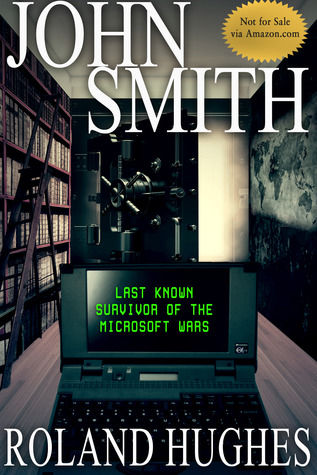
John Smith - Last Known Survivor of the Microsoft WarsI won a copy of Roland Hughes‘ book, John Smith – Last Known Survivor of the Microsoft Wars in a LibraryThing member giveaway.

Description from Goodreads:
What if the Mayans got the start of the end correct because they had survived it once before? What if our written history was just as accurate as the old tale about three blind men describing an elephant? What if classic science fiction writing and television shows each got a piece of it correct, would you know which ones? If your eyes can only see a tiny portion of a collage do you know it is a collage?

Fans of Babylon 5, Star Trek TNG, Battle Star Galactica (the new one) and classic science fiction writing will enjoy the bountiful Easter Egg hunt contained within. When you were a child you learned to connect paper clips or thread beads together to make a necklace. Sit back and watch the beads you’ve had all your life form the picture you could not see. Consider for one second the possibility of the story, then hang onto your mind with both hands while you take the ride.

Review:
Take all of the current conspiracies about governmental Big Brother, immigration, outsourcing, war on terror, biological weapon research, operating system back doors, etc, roll them into one and you have this book. It is a cautionary tale about the dangers of American complacency. Granted it is presented as relevant to the world and pretends to be culturally inclusive, but it is very obviously centred in and focused on America. I almost wonder if the author realises this or if it really was just a case of unintentional ethnocentrism. 

I can respect the intent of the book. I really can. Unfortunately, I was insulted on any number of fronts by it. To start with, John Smith is a condescending jerk. Reading his interview with Ms. Krowley felt a lot like witnessing the all-knowing man impart knowledge too heavy for the poor widdle woman to understand. Gag. This is before you even consider all of his sexist comments, which are probably supposed to be some failed attempt at humour. He sure seems to have a  low opinion of women considering he claims to have never ‘known’ one. Glad to know he’s ensuring male elitism makes it into the new human cycle. Wouldn’t want to loose that.

At least Keowley had enough of a backbone to come back at him with the occasional ‘stop belittling us,’ but usually demurely responded ‘Oh’, when he responded with some form of “Yes, but…” Despite appearances, he made no effort to actually educate her. He lectured her, patronised her, and generally talked down to her.

She was constantly left with little recourse than to state ‘you’re not making any sense’, to which he would respond by reminding her of her inferiority by pointing out that she didn’t have the knowledge, ability, or frame of reference to understand. But he actually wasn’t making any sense, because he was speaking to her with clipped cryptic statements meant to bait her into admitting her ignorance before he finally deigned to reveal the pertinent information and explanations. It was patronising as well as just plain annoying after a while.

Further, I understand that the people of Earth were meant to have lost a lot of their technology and  Smith, therefore, needed to explain things to her. But as a modern person I do understand  tech. So I found it really boring to slog through explanations I already knew–what a CD/DVD is and how it’s made for example. And this was a lot of the first half of the book.

Plus, I have no idea how he was supposed to even know all of it if he was 11 when he entered his bunker. Yea, I get it that the family tried to preserve knowledge by including books, etc. But a lot of his biases (against politicians, MBAs, religion, etc) are personal biases and I don’t see how they would have developed outside of experience. It feels very much like he’s just spouting off his own beliefs and presenting them as indisputable facts.

He also spoke in terms of “I had,” “I bought,” I stored,” etc in reference to his bunker. Taking credit for the forthought. Again he was 11 when sealed in. He probably didn’t do anything to prepare. His parents did. He doesn’t deserve to take credit for their preparations. It just adds to his condescension and my dislike of him.

I also have a lot of trouble with the amount of knowledge lost. The book seems to assume that all learning was lost at the end of the cycle. This ignores the fact that obviously some humans survived and with them would be some knowledge. Do you really think the world would forget what god is within 68 years? I’m not making a religious statement here. Just using an example. It’s a pretty ingrained or widespread belief within human. I could see religions falling by the wayside, but the whole idea of a higher power, not so much. Really, not one survivor ever mentioned it to their children? Then, to complicate the matter, Krowley seems to know random things she probably wouldn’t if one accepted the lost knowledge premise. What cloning, or pure grain alcohol, socialism, or the third world are, for example.

I also found it uncomfortable that Smith was relating all this information as if the world should simply be recreated in its old image. Stating things like, “…ships are always referred to as female, while boats as male.” Are, not were. It’s an interesting little tidbit of information, but the woman doesn’t even know what a boat is, so what does it matter if it’s named after a male or female and maybe in the new cycle that won’t be the case. Smith seems completely unable or unwilling to concede that things might be different this time around. Which, I might add, would completely devalue his role as keeper of the knowledge.

The author states on the back of the book that fans of Babylon 5, Star Trek TNG, Battle Star Galactica and classic Scf-Fi will enjoy the book. It’s great that he has a target audience and makes it so apparent, but I see no evidence that this book would appeal to us more than others. It has NOTHING in common with any of the shows. NOTHING. It isn’t even set in space. It doesn’t have a similar plot. It doesn’t have the same character types. It doesn’t have the same feel or tone. It doesn’t inspire the same sense of inspirational awe at the possibility of human accomplishments. It has nothing in it to recommend it especially to the Trekkie fan-base. 

The book does remind me a lot of Message from a Hidden Past (by Jos Rogiers) with a less likeable narrator. The writing was perfectly passable and it was well edited. But the question and answer, interview transcript is painful to read. Again, it’s not that it is badly written in any way, but it’s absolutely impossible to loose yourself in. I appreciate the opportunity to read the book, but I can honestly say this one wasn’t for me. My final say: Ethnocentric drivel. 

King's Mark

Book Review of King’s Mark, by Stephanie Herman

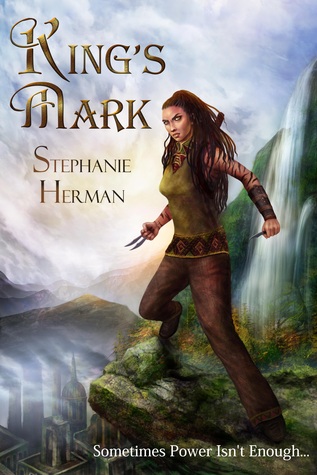
King's MarkAuthor, Stephanie Herman, sent me an e-copy of her fantasy novel King’s Mark.

Description from Goodreads:
Chay isn’t blind; she’s just pretending to be. Some street flies fake disabilities to earn sympathy and extra coin, but Chay took up the blindfold to hide the birthmarks that condemn her. If she slips up and someone realizes what she is, she’ll be tortured and killed.

There is nothing Leti loves better than hunting along the river and practicing his stone carving. Until now, his clan’s protection has allowed him to do just that, ignorant that the birthmarks on his hands brand him a traitor. 

Del Nyla lives in exile and regret, selling her swords to anyone who will pay. Every day, she risks her life in the hope that she might lose it.

These are the remnants of the King’s chosen servants, masterless and scattered. But not for long. Someone is gathering them together.

Review:
King’s Mark falls on either extreme of my mental tally sheet. In some respects it deserves the highest praise and in others it falls rather flat. My criticisms don’t outnumber my compliments, but they are rather major in the grand scheme of literary enjoyment…or at least my own literary enjoyment.

The book had a really interesting premise, but despite its length seemed thin on the important details. There were a lot of plot points the reader just had to take on faith with no explanation. Why did the king leave? What’s up with an immortal king anyway? How was he able to give people the Mark? What was Pris’ relationship to Chay and why was Chay so protective of, not to mention responsible for, her? How was a whole country convinced to buy into the persecution of the Marked they had previously loved so? Who was the Steward? I know what he was, but, who was he? Why were some Marked, Del for example, able to walk out in the open while other Marked were executed at birth? There was a lot of history between Isra, Del, Samuel, and Ket. What was their previous relationship?

Despite these remaining questions the story is an interesting one. It speaks to the dangers of too much power in the hands of too few and the injurious nature of disillusionment. It has strong undertones of the pain that almost always accompanies both the loss of innocence and the mantle of responsibility. It highlights the difficult decisions inherent in fighting for change and the need to accept loss for the greater good. And everywhere people are facing sacrifice of one nature or another.

There was also an interesting cast of characters. The dangerous and emotionally frigid Del. The steadfast and loyal Maro. The naive innocent Leti. The street-smart, battle hardened Chay. The visionary revolutionist Ket. The wounded warrior Ward. The embittered follower Isra. The list goes on. The book is full of strong character types (maybe even archetypes), even if those characters themselves sometimes felt a little shallow. I would have really liked to know more about almost everyone’s past. Because the history in this book played a very prominent role in the story. Honestly, it felt a little bit like I was reading a sequel without book one.

It was also bit slow to get moving. The main characters don’t even meet until half way through the book and some still never interact beyond introductions. This left me feeling like I was reading two or three parallel stories, as opposed to one strong, interwoven tale. As an example, I really loved Del and Maro’s interactions, but Maro never even met the younger Marked and, though he effected Del’s decisions, he played no notable role in the main events. Meaning his thread of the story never felt fully tied in.

Lastly, I had a lot of trouble with the characters’ ages. Both because they weren’t always explicitly stated, Leti was somewhere between 13-15 for example, and because some of the characters just seemed far too young for the characters they play. For example, Chay seemed to have a particular flare for whipping people, adult people, to revolutionary action but then about 90% through you find out she’s supposed to be twelve. Seems a little too young to be taken seriously. Then sometimes their ages contradict their lives and/or the timeline. Unless I misunderstood, Del was roughly 25, but Maro who was 19 grew up listening to tales of her battle prowess. Was she sent to war at 5ish? All in all the ages felt a little like a muddled mess.

The writing, however, is really superb. Character’s had regional speech patterns that gave everything a bit of colour. Heck, there was even an amazingly communicative mute. That can’t be easy to write. I especially appreciated the fact that Herman didn’t flinch from the tragedy. People died, sometimes in horrific ways, with no reasonable expectation of rescue. Anything less would have compromised the integrity of the story.

King’s Mark is worth picking up, worth the time it takes to read. Just go in knowing all of your questions won’t be answered, knowing that you just have to accept some things as the way it is. But when facing the dyeing, morally diseased corpse of the city of Durata maybe it’s unreasonable to expect anything else.