Up for discussion: writing reviews of books you dislike that are also outside your preferred genres

How do you handle writing reviews of books you didn’t like that are outside of your normal reading genres? This is a quandary I’ve found myself in more often since opening myself up to review requests. I get requests from all genres and try to read a little of everything. I also choose a lot of books from Amazon’s KDP and make a concerted effort to not let myself fall into only downloading one type of book. Though by and large I download a lot more PNR than anything else.

This, however, is a prime example of why I try to force my horizons open. Until about this time last year I didn’t read romance of any sort, paranormal or otherwise. Now it’s one of my favourite genres. I’ve gotten older. My tastes have changed. Maybe I’m a little more of a cougar than I used to be, I don’t know. At some point, though, I had to branch out and give that first PNR a chance.

The honest truth, however, is this doesn’t always work. I’m not going to like everything I try, but does that mean I shouldn’t be allowed to then write a review stating that I didn’t like the book? To clarify the question, does the fact that I’ve historically not liked the genre somehow negate my actual dislike of a book or social permission to express that opinion? What is a book review, after all, but my own personal opinion of what I’ve just read? I’ve never promised anyone an impartial review and don’t even know that it’s really possible to write one.

I recently posted the following review on Amazon, along with a 3 star rating. It is what prompted this particular exercise in crystallising my own opinion through public discourse. I’ve purposely removed any reference to the actual book. The intention here is not to IN ANYWAY disparage the author or her book. It is simply the impetus of the discussion.

I’m not claiming any real anonymity though. It wouldn’t be difficult to scroll through my Amazon reviews and find the one, but the book isn’t the point of this post. What is and isn’t considered acceptable by the review reading public is. Please understand that. This also isn’t a disguised attempt to defend myself against a perceived attack or to have a go at the commenter quoted below. I don’t want to get mired in any ill-conceived author/reviewer behaving badly quagmire. 

The review:

Oh God, I wish I hadn’t read that. I don’t know why I did it to myself. I know I don’t like this kind of story. I do. But I was tempted by the sarcastic tone of the description, which I admit runs through out the story and is just as funny. Honestly, I’m not even saying it’s not a good book and everything that women who like mushy love stories and frail, save me from myself heroins appreciate about the genre. I’m just not one of those women.At 27% through the book I posted this status update here on Goodreads,

I’m ~25% in and I know things are going to change, but as of this moment I’ve decided that a more satisfying rewrite of this story would be: Julia was having a bad day, week, month year. Stranded on the side of the road with a flat tire she doesn’t know how to change, Joe stops to help. She is then such a bitch to him that he gets back in his van, drives away and leaves her there like she deserves. Seriously!

The problem is that it didn’t change. Julia remained a completely bi-polar, possibly psychotic witch who did NOTHING to deserve Joe—who was of course wonderful in every tall, blond, muscled, 8-inch, committed, loving way.

To top it all off I don’t get the who lied about being a cop theme that the plot hinges on. First off, so what? He a cop, big deal. Second, he DID TELL HER he’s the chief police. The fact that she didn’t believe him doesn’t negate the fact that he told her. Plus, even if he hadn’t told her he told her enough of what he does for a simpleton to figure it out. It’s not his fault if she’s just too stupid to read the large, neon, flashing, heroic sign he paints for her.

Wylde’s writing is perfectly readable and, like I said, it is funny. But This was definitely not a good match for me.

Within a day two people had marked it as unhelpful and one person commented, “This is the worst review that I have ever read. If you don’t the genre DO NOT BUY THE BOOK!!! Unnecessarily harsh and mean spirited.”

The commenter’s instruction to not buy a book in a genre I don’t like is my point of primary interest here. Am I not allowed to negatively review a book I disliked simply because I admit that I’m not a fan of the genre in general? I’m not a huge fan of contemporary, depression era fiction either but I recently wrote a positive 4 star review of Sandra Brown’s Rainwater.

Now I understand the commenters point. She appears to feel that I’ve punished the book for not being in a genre I like. Something that is obviously not the book’s fault. I’ll also concede that this was a more vitriolic review than I normally write and I have, hence, rewritten parts of it to try and  pull it back a little bit. But I’d also point out that I gave the book 3 stars, and in an attempt to be balanced stated that it is funny and the writing is good. I also feel that the points I made about not liking the female character and not understanding the police officer angle are still valid ones. They would be the same even if found in a book from a genre I claim to love. But what are my…well, I don’t want to call them rights as a reviewer, because that would be too weighty a word, but I don’t currently have a better one? So we’ll go with that. 

I am, myself, an intrepid author. I understand how important reviews are, good and bad. No one pays attention to a book until it has a few good reviews and a lot of people don’t take your reviews seriously until you have one or two bad ones. As such, I review EVERY BOOK I read. This leaves me in the predicament I found myself in while writing the above review. I could either a) lie and say I liked it when I didn’t, b) write a vague, uninformative review that gave no real information, c) write an honest opinionated review, or d) not write a review at all. 

I suspect a lot of people would tell me to go with option D, since ‘if you don’t have anything nice to say don’t say anything at all’ is a fairly common mantra on the indie book circuit. It’s also one I have been fairly vocal about disagreeing with. A reviewer’s reviews are worthless if all filled with nothing but praise IMO. This, however, is a debate that could easily fill a post or two of its own and I’ll not let myself be distracted. Let me just say that option D wasn’t an option for me. As stated, I review everything I read. To skip over this one would be according it special treatment that I had not reason to offer. 

While not uncommon in practice, I doubt anyone would really advise me to take up option A or B either. That left me with option C, an honest and admittedly opinionated review. But what to include? I strongly suspect the, “I know I don’t like this kind of story” portion is the where the trouble arose. I, however, see a place for it there. I choose whose reviews to give most credence to by which reviewer seems to be the most like me. Like many people I have certain reviewers I pay special attention to because history has proven we like and dislike similar things. So informing the review reader which type of book reader I am helps inform them whether or not we might have similar tastes.

That’s my defence for having initially included it. However, like I pointed out, I’ve taken it out. I think it probably prevented review readers from clearly seeing the rest of the review. They may have seen it and immediately assumed everything after it was biased.  I can even understand that thought process. It does however ignore the fact that, unless I’m being accused of reading the book just to write a means spirited review of it, which I don’t think I am, something about the book attracted me to reading it in the first place. In this case the sarcastic narrative style. 

So the question I’m ending with, the small token of information I’m hoping to garner from you the reader is, am I right? Should I openly and honestly be able to say I generally don’t like this type of story, while also being able to separately declare myself to have liked or disliked this particular story or is that just being naive? Will the former always eclipse the latter? If that’s the case, how would you advise I handle such situations in the future. I see no one complaining about reviews that start out ‘I don’t usually like genre X, but loved this particular book.’ In this case the general dislike of Genre X only serves to heighten the importance of liking the book in question. It obviously doesn’t work in reverse. 
Transit of Ishtar

Book Review of Natalie Gibson’s Transit of Ishtar

Transit of Ishtar

Author, Natalie Gibson, sent me a copy of her paranormal erotic novel, Transit of Ishtar. You can see my review of the prequel, Ishtar Bound here.

Description from Goodreads:
Nathalia Lovejoy should be dead, she can remember committing suicide, but she wakes up in a ancient tomb. Her voice destroyed, she must rely on a new source for her magical ability, telepathy, in order to communicate with her savior. Nathalia has a real distaste for men. Lucky for her, Eiran Kafziel is not a man. He is a demigod, a halfbreed, unlike anything she has ever known. He found her in the moment of her death, repaired her body, gave her his holy blood, forever changing her into a Sinnis. She must come to terms with the fact that she is attracted to him, even loves him. 

Along the way she discovers a whole world of mythical creatures living among humans. She battles her own hunger for violence and releases a demon from his 500 year prison. Can she become the weapon against that newly freed evil and save the world from his plans, or is she better suited to be his dark queen?

Somewhat spoilerish Review:
I have to be honest. While a fine story, I didn’t like Transit of Ishtar as much as its prequel, Ishtar Bound. It was a very different book. It really gets the Sinnis series rolling and while Ishtar Bound was relatively self-contained this one felt very much like the start of something bigger. There were a lot of explanations that will, no doubt, carry through the rest of the series. On the up side of that, a number of the questions I was left with at the end of the last book were answered here. That was nice. I appreciated that.

There was also a lot more sex. After finishing Ishtar Bound I commented that I didn’t think it earned it’s erotica stripes. This one does, no doubt about it. It wasn’t really my type of sex though (and that’s my one main hang up on this one). I know that sounds weird. We all have preferences about different things. In this case, I’m not a huge fan of the overly dominant male sex partner. I have no problem with the alpha male or even male dominance in sex, but there is such thing as too much. And for me it’s the type where he allows his partner almost no freedom and whose behaviour if phrased differently would plainly be abusive. I just don’t find that sexy.

Natalia really could have just been a blow up doll at one point for as much control she had and conscious contribution made. It makes whole scenes feel like a rape even when they aren’t, no matter how many times the reader is reminded that she is enjoying it (and that’s on top of the actual and inferred rapes in the book). But I have a particular problem with it when the woman involved was until that point a staunch femi-nazi lesbian. I mean she HATED men and would have never allowed herself to be so dominated by one. On more than one such occasion I wanted to snarl on her behalf. It didn’t at all fit her personality. Having sex with a man at all was a stretch, but then to enjoy rough, dominated sex just wasn’t reconcilable.

I also had questions about what I’ve deemed ‘the Michael question.’ Nathalia was fairly clearly presented as a sexual as well as physical victim of Michael in Ishtar Bound. She was even forced to play some sort of relief game, where she had to get him off before passing out from asphyxiation while he strangled her. But she’s still a virgin (her hymn is intact), is shown in this book to have never gone down on a man before and doesn’t appeared to have been raped in any other fashion. So, I’m left wondering what exactly it is that he actually did. I ask because Natalia was simultaneously, or rather intermittently presented as having both a history of sexual abuse and being completely naive about male/female sex. I’m fairly sure that at least in this case the two are mutually exclusive.

Then there were the prehensile wings, which Eiran often used as an extra set of hands. It was just plain strange. I couldn’t help imagining all that old Japanese anime full of tentacle rape (or shokushu goukan according to Wiki). It was a little bit too much for me and that’s before I even address the vibrating penis.

Here’s the rub though. Even as I cringed and occasionally snarled it was still pretty hot, the teaser for book three even more so. It’s apparently a m/f/m and m/m/f grouping. But the whole thing is beginning to feel like in order to up the anti each book is moving farther and farther into the extreme. The first book had a purposefully dominant male/female pairing establishing a mutually loving relationship. This one had a previously reluctant female lead with a unremittingly dominant and almost cruel male (though only during sex). The next moves into threesomes, bisexuality and BSMD. I’m afraid to ask where the fourth will go. Snuff? [BTW, I’m not in any way comparing those, just pointing out that the themes seem to be escalating.]

Complain as I might I still have to give major props for an original story and wonderful writing. I’m even tempted to give book three a shot, ’cause the teaser really was steamy and I like m/m pairings. But I am a little afraid that two men and one woman just means two men to use the one woman. There was already a little of that in the preview, with the whole ‘cage our little birdie’ bit and seems to be the president in the first two books. Though I really don’t think that is the intended message in any of these books, that’s how the sex in them all so far feels to me and I find it off putting. In fact, it’s my only real, though major, criticism of the novel. And it’s one others may not share.

I am 100% aware that my opinions are just that, my opinions. Others may or may not agree or feel the same. I like the story set up in this book for the rest of the series, I generally like the characters and, though I find the tone distasteful, the sex is hot (even if I admit that begrudgingly). You’ll have to decide for yourself if it’s the sort of thing you’ll like or not.

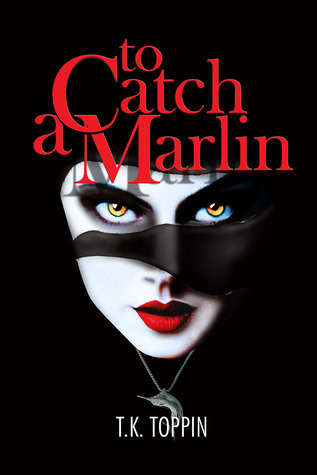
Book Review of T.K. Toppin’s To Catch a Marlin

To Catch a MarlinI grabbed T.K. Toppin‘s To Catch a Marlin from the Amazon KDP list.

Description from Goodreads:
In the tail end of the 24th Century, Special Inspector Michael Pedroni pursues a beautiful and elusive vigilante, Jax Marlin, in a wild cat and mouse chase that will take him from Earth to the Bacchus Dome and beyond.

Jax Marlin is not your average criminal; she seeks out evil-doers and law-breakers, doling out justice in whatever way she sees fit. But lately, she finds she’s been gift-wrapping criminals specially for her favorite copper.

Four of the world’s leading criminals are determined to form an alliance. Jax is determined to stop them. Hot on her heels, Inspector Pedroni finds himself questioning the difference, if any, between her justice and his. More than that, he wonders why, when he’d had her in his grasp, he was unable to slap on the restraints and bring her in.

Both want the same thing–to stop criminals. But the growing attraction each has toward the other becomes a dangerous hindrance.

Review:
First off, I love this cover. Props to whomever designed it. The story’s pretty good too. The first 10-15% felt like it just rehashed the book’s description repeatedly, but after that, the action seemed to pick up. Pedroni and Marlin’s cat-and-mouse game was amusing, as was the way Marlin managed to stay one step ahead of Pedroni but was never too far away. Her affection for him softened her personality and made it a lot easier to relate to her. Without it she would have felt too cold to like, too mechanised. She was pretty much good at everything: fighting, tech, disguise, etc. I was left wondering exactly how she became so awesome. The answer was hinted at, but I still would have liked to know how exactly that came about.

Pedroni was wonderful. He’s the epitome of ‘good cop.’ He reminded me a little bit of Asimov’s Elijah Baley, but that might just be an effect of a New York detective in space. I enjoyed watching him struggle with his role as the Special Investigator in charge of catching Marlin and his growing feelings for her, as well as his increasing understanding of her motives. I really wanted them to have their happily ever after, but I’m happy with how the book ended. Anything more would have been unrealistic.

All in all, I have very few complaints. It was a sweet story, with some good fight scenes and truly evil baddies.