Category Archives: books/book review

Moments in Time

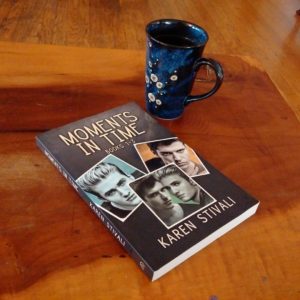
Review of Moments in Time (Moments in Time #1-3), by Karen Stivali

I won a signed copy of Karen Stivali‘s Moments in Time (#1-3) from Just Love Romance. I read it as part of my #DiverseRomanceBingo challenge, as it contains a bi character, Jewish characters and is written by an #OwnVoices author.

Description from Goodreads:

Moment of Impact
Beyond Collin Fitzpatrick’s dorm room, the students of his conservative college think he’s straight, as does his Catholic family, who’d disown him if they learned the truth. Inside, he’s safe with his sexy roommate Tanner D’Amico. Tanner wants to show the world how much he loves Collin, but Collin’s not sure he’s ready for the impact stepping outside will make.

Moment of Truth
Collin expected to spend another summer fixing cars and working at the college pizzeria. Instead, he’s living in a beach house on Fire Island, and for the first time, he and Tanner can publicly be known as boyfriends. Being “out” takes some getting used to, and doubt and jealousy threaten their happiness. Collin and Tanner must confront the truth or risk losing it all.

Moment of Clarity
Spending the summer on Fire Island brought Collin and Tanner closer than ever, but back in their conservative college town, new challenges confront them.

When Collin’s relationship with Tanner becomes an issue in his brother’s custody battle and Tanner struggles with feelings for his heartbroken friend Wendy, Collin wonders if everyone would be better off without him. In order to save them both, Tanner must make it clear his love for Collin is all that matters.

Review:

Hmm, there is plenty to appreciate here. It’s a sweet read about two university-aged guys falling in love. And it is sweet. It’s nice to see a confident bi character. It’s nice to see Catholic and Jewish characters. It was nice that the guys didn’t go from virginal to straight porn sex in an instant and that sex could be something other than penetrative. I liked that there wasn’t a lot of angst about who did what to who and what that did or didn’t make them. I liked Collin coming exploring himself for the first time and Tanner’s patience with him. And I just plain liked Collin and Tanner.

However, the plot often felt like little snippets of life between extended sex scenes. There was far too much sex for me. Not that I mind a lot of sex, but the balance of sex to plot felt too heavily weighted toward sex. I got bored with it. I thought a lot of the conflict felt contrived (and often predictable) and the easy way everything miraculously resolved itself in the end was too pat and easy to be believable.

Lastly, I had major concerns with the representation of women in the novelettes. There are basically only six women in the whole book. One is the classic saintly mother. Of the other five, one was willing to abandon her friends for a boyfriend and willing to steal another’s lover. A second was a wife/mother who cheated on her husband, abandoned her children and was vilely homophobic. A third was a homophobic mother that disowned her gay son and the last was a girl who actively pursued a man she knew to be in a committed, monogamous relationship. I get that this is a book about men loving men, but why does that mean women are so often only presented as the enemy? As if we can only be saints, which less face it removes them from the human realm and consideration, or dangerous to the male characters in the book?

For the most part however, I enjoyed this and have no real qualm recommending it to readers.


What I’m drinking: Loyd: The Magical Experience Flowery Earl Grey (seriously, that’s what it’s called!) I’d add a link, but it’s kind of frightening, in this day and age, how little web presence Loyd tea apparently has.

Chris Dinesen Rogers

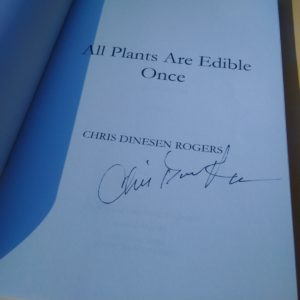
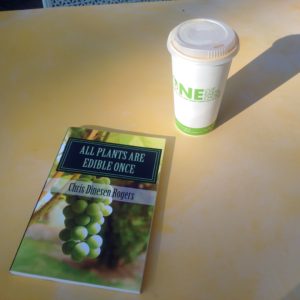
Book Review of All Plants are Edible Once, by Chris Dinesen Rogers

I won a signed copy of All Plants are Edible Once, by Chris Dinesen Rogers, through Goodreads:

Description from Goodreads:

Ever wonder how plants got their names? Or can you guess what plant has over 40 common names because of all its uses? “All Things Are Edible Once” explores the world of herbalists and folklore. Learn how plants we consider weeds now were an important part of historical use. For example, did you know that dandelions were brought over to America–intentionally? Or did you know that the Saxons used creeping Charlie in beer making? Learn these facts and more on a journey into the world of the herbalists.

Review:

If you are interested in the folklore use of mid-western American plants this is a fun little reference guide. It only includes about 40 plants, but they seem to have been carefully chosen. The book is obviously self-published. There is the occasional editing error, such as reference to a lover being spurred instead of spurned and some of the formatting wanders at times. BUT the narrative is very personable and conversational, making the whole thing feel like you’re reading a long lost relatives foraging guide and, personally, I feel like this matches the subject significantly better than a slicker, more professional version would. If you’re looking for a far reaching, covers everything guide to foraging this is not the book for you. If you’re interested in a local’s limited, but individualized account of her time in the wild give this one a try. I can more easily see this selling well in a park gift shop than Amazon, but it has a place on the shelves for sure.


What I’m Drinking: An almond milk latte from the Webster Groves Garden Cafe.

Graceling

Book Review of Graceling, by Kristin Cashore

Graceling

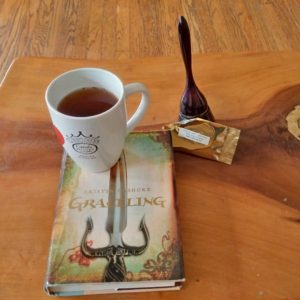
I bought a copy of Graceling, by Kristin Cashore.

Description from Goodreads:
Katsa has been able to kill a man with her bare hands since she was eight – she’s a Graceling, one of the rare people in her land born with an extreme skill. As niece of the king, she should be able to live a life of privilege, but Graced as she is with killing, she is forced to work as the king’s thug.

When she first meets Prince Po, Graced with combat skills, Katsa has no hint of how her life is about to change.

She never expects to become Po’s friend.

She never expects to learn a new truth about her own Grace – or about a terrible secret that lies hidden far away…

Review:
Well, that was a pleasant surprise. I went through a YA phase a couple years ago, but almost every YA book I’ve read since them has made me all sorts of ragey. This was an exception.

I thought Katsa was a marvelously strong female characters, but also able to be compassionate and kind. (Not just a man with tits, which is a very common misrepresentation of strong women in my experience.) In fact, learning this fact was one of her biggest challenges of the book.

I liked seeing a common gender trope turned on its head, as it’s usually the tortured hero, instead of a heroine. The few other times I have encountered this, it’s been accompanied by an inference that she struggles with her own violence because she’s female and a man wouldn’t be so bothered, because he’s strong enough to handle it. Making her reluctance to kill a gendered fault, not a moral dilemma. I never felt that here, even as Katsa fought to move past being little more than a brute. It was personal growth, not personal weakness.

We had male/female platonic friendships. We had supportive female/female friendships. (It passes the Bechdel test.) We had a same sex couple. We had a male romantic partner that was empathic, expressive and liked pretty things. We had a romantic pairing that was presented as valid, even when it didn’t end in wedding bells and baby bonnets. We had men willing to accept a woman as their leader and be more skilled than themselves, without feeling humiliated. So much to appreciate.

I did think Katsa’s dislike of dresses and hair and such pretty things compromised the authors attempt to make her both strong and female. Why can’t she be a strong fighter and like female things? It’s like she can be female and strong, but not feminine and strong. She can remain a woman, but she has to give up the trappings of her gender before she can be convincingly strong and valiant? (This is one of the few man-with-tits strong female character traps I noticed Cashore falling into.)

This and some of Katsa’s obliviousness and ‘specialness’ felt a cliched. As was the use of sexual deviance to make the villain especially evil. This is plot device that has been used so often that it’s lost all effectiveness for me. I see it and think, well, the author just grabbed a pre-formed baddie for this one, didn’t she? Sexual deviance is frequently used in books to telegraph that a man is not just a bad man (a bad man might just be violent), but a very bad man and if he targets children a very, very bad man. No depth or exploration of character needed, because these actions are already conveniently placed on the continuum of evil for reader connivance. Plus, I didn’t really think it matched the tone of the res of the book.

Lastly, I thought there was a notable change of pace between the first and the second half of the book and Katsa was a little too resilient, accomplishing things that really should have killed her, even with her Grace. But all and all, I enjoyed this book.


What I’m drinking: A sample of Gwy-u Latte, given to me by the proprietor of Traveling Tea, when I last visited. I’d mentioned that I enjoyed chicory and she thought I might enjoy Gwy-u Latte tea. I did, very much. It’s a “green guayusa herbal honeybush rooibos blend.”