Category Archives: Challenges

Noble Ark

Book Review of Noble Ark, by Colette Black

Noble ArkI downloaded a copy of Colette Black‘s book, Noble Ark, from the Amazon free list. At the time of posting, it was still free.

Description from Goodreads:
Mwalgi pirates, parasitic aliens who consume human spinal fluid, are boarding the Noble Ark. When Larkin Trovgar, a half-human member of the attacking alien ship, turns on his own people, saving Aline Taylor’s life, she feels duty-bound to watch over the impossible monstrosity. Despite his easy-going charms and virile physique, she’s determined to see him as she would any Mwalgi—nothing better than an animal. As Larkin’s presence brings out the best and worst in the human crew, and the Noble Ark is harassed by more Mwalgi ships, will Aline look past Larkin’s alien heritage to find love, or will mistrust cost her everything?

Review:
I think I probably enjoyed this more than it deserved, because when I started mentally tallying all the points I wanted to make in this review the criticisms outnumbered the compliments. But I still enjoyed it. Sometimes that just happens with a book. In such cases, I tend to go with my emotional response, even if not all together logical. So, the final takeaway is that I had fun reading Noble Ark.

The simple fact is that a lot of this plot is…*shakes head*…well, I couldn’t believe half of it. The amount of freedom of movement Larkin, an enemy hostage, is given is unprecedented.

But before I even get to that though, there is the fact that almost everyone on board the ship hates the Mwalgi, except for a few convenient people in Aline’s life who suddenly and inexplicably turn out to be Mwalgi sympathisers. Most notable of these are the family of her best friend and her therapist. Isn’t that convenient to the plot? The people most likely to bring her around to not hating Larkin are the only ones who don’t hate his kind to start with.

The necessity of putting Larkin in Aline’s room, instead of the brig is utterly ridiculous. Even if your father is the captain, especially if your father is the captain, there’s no way he’s risking your life like that just be cause you ask. NO WAY! There had yet to be any indication to anyone but Aline that he was anything but the blood-thirty monster all other Mwalgi are seen as.

Then he’s allowed to walk around with her mostly because, and I shit you not, her psychiatrist tells her to spent more time getting to know him. Sure, “Bring your enemy, alien hostage to your therapy sessions, where we’ll talk about all your personal trauma in front of him.” seems like a perfectly normal AND BELIEVABLE thing for a therapist to insist on. At the very least, that has to be a HIPPA violation.

What’s more, dehumanising the enemy during war times is the norm, not something her counsellor would be having kittens over in the first place. So, why does he want her to get to know him and see him as more human? No one, NO ONE, else is concerned with seeing the enemy as human. (For that matter no other Mwalgi in the book are presented as human, they’re all shown to be the evil monsters people believe them to be.)

Plus, when the few important characters who don’t see them as monstrous all give Aline the  ‘but we’re all human, really, it’s just our governments that are at war’ it felt forced and was unpleasantly sappy. It was the most juvenile part of the book and despite the books’ general lack of believability, one of the few time I found myself truly disappointed by it.

Another one was the games. I found it unlikely that Larkin would have been allowed to participate, convenient archaic rule or not and I find it even more unlikely that other participants would play with him. Realistically, most should have been traumatised by the sight of him.  Plus, they just lasted for flippin’ ever! I thought they might never end, detailing every single stage and points scored as the section did.

I also found the onboard baddie, David, shallow, uni-dimensional and too insanely focused to be as smart as he was said to be. This is very much a YA sci-fi romance. A lot, A LOT, more time is spent on board with Larkin, Aline and David that with enemy engagements. So, for most of the book this angsty teenage attempt at romance is the main focus.

Given that so much attention was paid to the onboard drama, a lot less attention was paid to the galaxy and general world-building. I was often confused on what the treaties and conventions that were obviously being ignored were meant to actually establish, who/what species were, how many types, was there a multi-world alliance of some sort, etc. This was a very real weakness.

Now, I did really appreciate that the author allowed bad things to happen. I don’t mean I like bad things, but in circumstances in which there can be no happy ending, the reader needs to know tragedy can strike. But many authors aren’t willing to go there and I’m glad Black did.

The book is well written and I didn’t notice any glaring editorial errors. Plus, like I said at the beginning, I really enjoyed the book. Larkin is a wonderful hero and, with exception of her extreme and annoying naivety concerning David, Aline was a strong fun heroine. There were some interesting tech and species described as well.  So, though I had a lot of complaints, I’d still recommend readers pick it up. You kinda gotta give up on reasonable believability and just go with the flow, but if you can do it, it makes for a pleasant read.

Book Review of The Iron Duke & Heart of Steel, by Meljean Brook

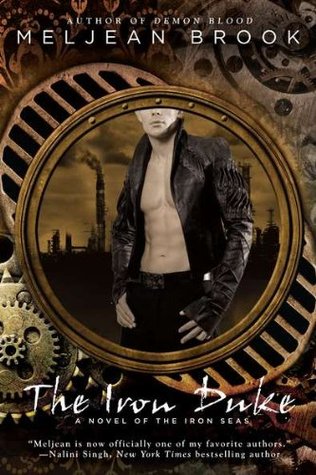
The Iron DukeI checked out Meljean Brook‘s The Iron Duke and Heart of Steel from my local library.

About the book:

After the Iron Duke freed England from Horde control, he instantly became a national hero. Now Rhys Trahaearn has built a merchant empire on the power – and fear – of his name. And when a dead body is dropped from an airship onto his doorstep, bringing Detective Inspector Mina Wentworth into his dangerous world, he intends to make her his next possession.

But when Mina uncovers the victim’s identity, she stumbles upon a conspiracy that threatens the lives of everyone in England. To save them, Mina and Rhys must race across zombie-infested wastelands and treacherous oceans-and Mina discovers the danger is not only to her countrymen, as she finds herself tempted to give up everything to the Iron Duke.

Review:
Oh, this was marvellous! I adored just about every aspect of it. Mina is a wonderful action-oriented heroine. The Duke is a great alpha hero. (He does come across as a little too alpha, borderline rapey in the beginning. But it’s also kind of fun seeing him learn how not to be that way.) And the side characters, they’re also amazing.

There are all the expected steampunk elements–mechanical men, zombies, kraken, airships, etc. There’s a very intricate and intriguing dystopian world, exotic local and romance.

But I also really appreciated that the book is adult themed. Not erotica or anything like that, but it explores some very dark human elements and a lot of people in it have a history of abuse. This was all handled without feeling extraneous to the plot or pointlessly titillating.

Plus, there are real, grown up main characters. She is almost 30 and he’s past his mid thirties. I appreciate not having to imagine 21 year olds with the bearings and life experience of older characters. Much better to just be given an appropriately aged character in the first place.

There was a bit of insta-love. I could have done without all Mina’s tears in the end and some of the ‘misunderstandings’ were cliché  and predictable.  But my final says is *winner.*


About the book:

Heart of SteelThe Iron Duke introduced the gritty, alluring adventure of the Iron Seas, where nanotech fuses with Victorian sensibilities—and steam.

As the mercenary captain of Lady Corsair, Yasmeen has learned to keep her heart as cold as steel, her only loyalty bound to her ship and her crew. So when a man who once tried to seize her airship returns from the dead, Yasmeen will be damned if she gives him another opportunity to take control.

Treasure hunter Archimedes Fox isn’t interested in Lady Corsair—he wants her coldhearted captain and the valuable da Vinci sketch she stole from him. To reclaim it, Archimedes is determined to seduce the stubborn woman who once tossed him to a ravenous pack of zombies, but she’s no easy conquest.

When da Vinci’s sketch attracts a dangerous amount of attention, Yasmeen and Archimedes journey to Horde-occupied Morocco—and straight into their enemy’s hands. But as they fight to save themselves and a city on the brink of rebellion, the greatest peril Yasmeen faces is from the man who seeks to melt her icy heart.

Review:
Well, we have another winner! I very much enjoyed Yasmeen and Archimedes’ story. Yasmeen was a great, strong female lead and Archimedes was like an anti-alpha. The man had some definite subby tendencies that I found adorable.

Though the world-building is as impressive as in the first book, I didn’t feel the plot was quite as expansive. Therefore, I wasn’t as wowed here as I had been with The Iron Duke (though I still really liked it).

I also thought Yasmeen’s attitude toward Archimedes seemed to shift suddenly and without a lot of clear reasons, especially considering how vested she was in not falling in love. Plus, as I’ve seen frequently in romances, the deeper in love she fell the weepier she became. This especially annoyed me as she was otherwise so…well, not unemotional, as she’s passionate and full of emotion, but also not one inclined to the softer emotions. Tears seem drastically out of character.

Despite a few little niggles, I’m in love with this series and hope my local library gets the rest of the series.

The Winter Boy

Book Review of The Winter Boy, by Sally Wiener Grotta

The Winter BoyI received a review request/unsolicited pre-approval from Netgalley (what should I call that) to read Sally Wiener Grotta‘s Speculative fiction novel, The Winter Boy.

Description from Goodreads:
The Valley of the Alleshi is the center of all civilization, the core and foundation of centuries of peace. A cloistered society of widows, the Alleshi, has forged a peace by mentoring young men who will one day become the leaders of the land. Each boy is paired with a single Allesha for a season of intimacy and learning, using time-honored methods that include storytelling, reason and sex. However, unknown to all but a hidden few, the peace is fracturing from pressures within and beyond, hacking at the very essence of their civilization.

Amidst this gathering political maelstrom, Rishana, a young new idealistic Allesha, takes her First Boy, Ryl, for a winter season of training. But Ryl is a “problem boy,” who fights Rishana every step of the way. At the same time, Rishana uncovers a web of conspiracies that could not only destroy Ryl, but threatens to tear their entire society apart. And a winter that should have been a gentle, quiet season becomes one of conflict, anger and danger.

Review:
I’m just going to come out and confess up front that this is a hard book for me to review, because I firmly believe it is probably a good book. It’s certainly well written (with the exception of a few too formal quirks I’ll get to in a minute). The problem is that it is also a book I didn’t particularly enjoy and thus its 508 pages felt all but endless.

At its most basic, my problem with the book is that it feels a little pompas, as if it’s trying so hard to be important and meaningful that it just feel staged. As a result, it strikes me as one of those books that we’re all expected to read and hop on the ‘it’s so deep and meaningful’ bandwagon. Meh, I saw where it was trying to go and what it was trying to do (It was hard not to, it was so heavy-handed), but none of it impressed me too much.

Plus, and this is a biggy for me, the Feminist in me squirmed. I had hoped that taking a group of widows with the intent of training men to be better men would feel empowering. Instead, it felt just like one more story in which women set aside their own lives and importance for the betterment of a man.

And I don’t just mean this in the sense that all books should be paragons of feminist mystique, but that from the blurb and numerous hints in the text itself I sensed that it was written with the intent to show women as equally strong, worthy contributors to the societal good. In this, it failed miserably.

Even more so since Ryl came from a society in which women blatantly don’t have equal rights (a fact that effects his beliefs and behaviours in the beginning but is then mysteriously dropped), but it’s quite clear that not all cultures in the book’s universe are supposed to hold with such inequality.  BUT you don’t see those cultures. You’re told they exist, but don’t see them. Every single culture that is discussed (and there are a lot of them) held women in positions of secondary status.

Regardless, it’s still treated as the norm. Rishana still submits to him in many ways, even as she’s said to be doing it to teach a lesson or because challenging him will not further a lesson. Meh, I appreciate what the book was trying to accomplish in this area. I just don’t think it was wholly successful.

If women are meant to have equal rights/powers/positions/respect in the country as a whole, even if not in all individual tribes, why do the Alleshi train ONLY MEN for leadership? It’s kinda a big deal and completely undermines what I perceived to be the book’s intent. Thus, it feels like one more text that touts female empowerment and delivers the “naturalness” of male leadership and women’s, at best, position as an advisor.

It reeks of the familiar myth that women can find true satisfaction and self-worth in taking a damaged or unrefined man and through her love and good heart changing him into a truly good man and live happily ever after. Which, if you take that one step farther, is the myth people used to teach young girls to make them passively accepting of being married to older or otherwise unappealing men.

It could have been something really special, if it hadn’t so often compromised itself by falling back into old, well trodden gender tropes that completely countered what I took to be the book’s intended message. Of course, my understanding of its intent, while valid (as I think any reader’s understanding of a work is valid), may not be the same as the author’s. I have no way of knowing. But this was a big deal for me.

There was unquestioningly a submissiveness to the lessons the Alleshi taught their boys, that is the woman appearing to submit to the boy. Yes, she’s doing it purposefully to teach him, but that same submission and how to expect and accept it is part of the lesson, especially toward the end when he’s supposed to have become an actual man.

There will be some who argue that given what is revealed toward the end, this isn’t the case. But for me it was too little too late. After all they were still only training men to go out, meet new cultures, make decisions and rule each individual tribe.

I did like the use of sex as a predetermined lesson. I appreciated that the author was brave enough to strike out from the cultural narrative that sex is only proper and acceptable for procreation or as an angelic expression of romantic love. It too is a myth and I found exploring other expressions and uses for it satisfyingly adult. Not in any illicit or titilating way, but by provoking thought around a subject most of us are fed a cultural belief system that we’re not supposed to question.

I also appreciate how obviously arrogant Ryl was in the beginning and how the author showed a lot of what most teenage boys probably feel. On the other end of the spectrum, if the arrogance of teenaged boys could be dispelled by good sex and pointed questions in a single winter all our lives would likely be better. It’s not particularly believable.

As I said the writing is largely very good. I occasionally found the dialogue ever so slightly unnatural. I realize it is often meant to be formal and it feels it. But I found myself gritting my teeth at the frequency with characters said “please.” I acknowledge that this is a strange comment, but used repeatedly between two people living together felt out of place. Similarly, characters, far too often used names and titles when speaking to one another.

Since I’m on the subject of names, the use of several names for the same characters seemed needlessly confusing. It is explained and I understand why it was done, but I found myself confused more than once. At one point, you have a single character referred to by three names in the space of a page. And there are several characters this is done with.

There is also a tendency to head-hop, which I found distracting, especially when numerous characters were involved. It was jarring.

Lastly, like Ryl, I got really tired of everything being a lesson. This is part of what I meant when I called it heavy-handed. There are so many ‘teaching moments’ that eventually I felt lectured to.  In the end, I wasn’t sure which the author saw as more important, the entertainment value of the story or the moral lessons she sought to teach the reader.

All in all, it’s an interesting story. With some interesting cultures and precepts. There is a large and detailed (probably dystopian) world developed here. I have no doubt that it will appeal to some. I found it long, tedious and full of things that made me grit my teeth in annoyance.