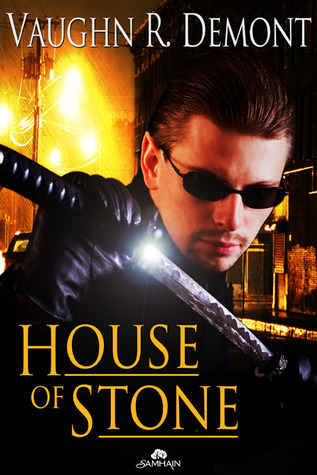
It appears to be Vaughn R. Demont week around here. First, I read and enjoyed House of Stone. Then, this happened, resulting in this and this. (Proving beyond a shadow of a doubt that when a community, even one stretched across the globe, decides to move a mountain, that shit shifts.) Then, I decided to give the Broken Mirrors series a try as well.
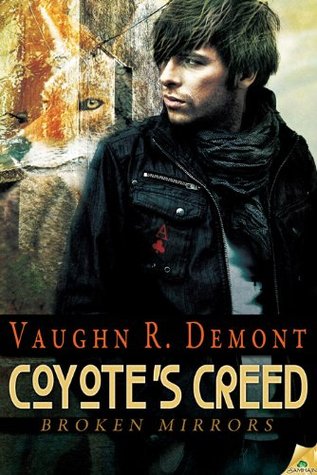 Description from Goodreads:
If con games were taught in high school, Spencer Crain would be on the honor roll. As it is, he’ll be riding the edge of failure to graduation next month. Then Spence gets the news that his long-gone father is not only dead, but was a Coyote, one of three clans of tricksters in the City.
With a near-catatonic mother on his hands, Spence couldn’t care less about the Coyotes’ ongoing feud with the Phouka and the Kitsune—until it lands on his doorstep. Suddenly he’s thrown headfirst into a dangerous world he knows next-to-nothing about. His only guide is Rourke, dashing King of the Phouka, plus a growing pack of half-siblings, a god, and Fate herself.
As Spence embarks on a journey to learn the Coyote’s creed, the truth about his heritage, and how to handle his growing attraction to Rourke, he wonders when his life turned from TV sitcom to real-life danger zone. And what price must he pay to survive the next roll of the dice…
Review:
Funny, funny, funny…maybe a little on the lowbrow side, with the endless blond jokes and such (and I say that while admitting that I liked it, so I don’t mean than in a snobby way). It fit the character so no complaints here. I found myself reading with a goofy smile on my face more than once.
I have to agree with some of the other reviewers who have pointed out that Spencer had a tendency to speak beyond his years, showing a knowledge a self awareness that isn’t particularly realistic in an eighteen year old—the type of knowledge and introspection that is only possible with a little age under your belt so that you can look back at your ignorantly self-assured teen self and see your own faults. But he was still a loveable rogue that I enjoyed spending time with.
Spencer’s sexuality played a large role in this book. Not in a pornographic way, but it was still an important aspect of the plot. I adored the fact that he was completely at ease with who he was in that respect. There was none of the angst or shame or just weighty significance to his bisexuality that is so often seen in literature. His ability to say (or not say, as the case may be since even saying it wasn’t a necessity) ‘I am what I am, so what?’ gave it an easy naturalness that is usually reserved for heterosexual relationships. This was really a pleasure to come across in a character. I’d love to see more such depictions.
I was a little lost in some of the supernatural aspects of the book. The idea of different mythologies existing beside each other is an interesting one, but it left plenty of gaps for a reader to wonder how things really worked, especially as it relates to the destruction and reformation of worlds, placement of the gods, and their relation to the paranormals of the book.
But despite these few niggles I generally really enjoyed the read. I enjoyed Spencer’s quirky, media-soaked, libidinous personality. I enjoyed seeing him learn new things without him feeling baselessly naive or taken advantage of. I enjoyed Demont’s ability to maintain a breathtaking pace without leaving the reader feeling rushed. I enjoyed the fact that the book is relaxed enough to let a series of stupid riddles carry a scene and still leave me laughing. All in all, well worth the read.
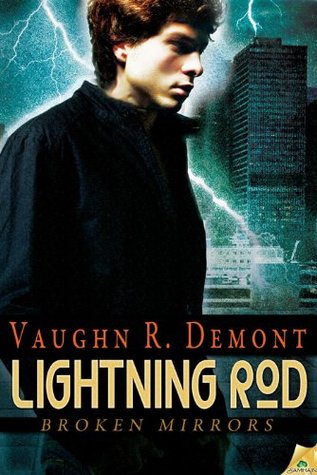 Description from Goodreads:
Sorcerers have always been feared in the City, their origins as unknown as the nature and extent of their power. When James Black, a young man fleeing an abusive lover, becomes a sorcerer, his old life is erased from existence, and his new life is indebted to powerful entities.
Escaping the man who abused him was supposed to be the end, but the very magic that freed him has put him on a collision course with the gods and the Sorcerer King himself.
And only one of them can survive.
Review:
Hmmm, how do I start with this one? You see, I’m a little uncertain of my footing. I really enjoyed book one of this series (as well as House of Stone, by the same author), and while this seemed an OK read, it just didn’t stand up to the other two books by Demont that I’ve just plowed through. So where does that leave me and my need to review it?
Mostly I feel that the book didn’t have that certain something special the other books did. The main character was a victim, and while he grew in strength and determination, he didn’t have the humor I loved in some of Demont’s other characters. In fact, I found that James never particularly endeared himself to me. I cared little for him by the end of the book.
I also thought the weave of the plot wasn’t as tight. There were a lot of times that I either couldn’t quite visualise what was going on or wondered how something happened. For example, at one point, James had to cross into a magical circle, and in order to do so, he had to go through a fairly elaborate ritual. Shortly thereafter, someone else crossed the same circle with no such ritual. How? Similarly, Heath is stated to have been untrained; however, a very short while later, he showed some pretty impressive skills. How?
In every Demont book I’ve read, the side characters haven’t been as richly tapestried as the main ones. No real problem; that’s just the way it is. But here, it felt extreme. The primary antagonist only showed up sporadically, had no depth, was unilaterally evil and prone to evil villain speech. I didn’t find him particularly believable.
Then there was the sex…or not sex as it would appear. I’ve really enjoyed Demont’s ability to write a sex scene that is both gratifying and not overly pornographic…no that’s not quite right (I don’t mind pornographic); rather, I mean, sexy without also stretching the realms of erotic possibilities to the point of fantasy. However, here the sex was rushed and undetailed. We were essentially just left knowing it happened. Meh.
Now, having said all that, the book does still have Demont’s trademark geektastic comic streak. There’s a Marvin (though I think I would have appreciated him more if the character hadn’t felt the need to explain the reference to the reader). There were Dungeon’s and Dragon’s references. There were potshots at the LARPers. The book is still a fun read. But, honestly, I don’t think it stood up to Demont’s other works. I’m told that the series redeems itself in book three, though. So there’s still hope.
 Description from Goodreads:
The King is dead, long live the King. And, uh, could you float him a couple bucks?
Life as the only human sorcerer isn’t all it’s cracked up to be for James Black, the Lightning Rod. Between gremlins in the closet, paladins crashing through skylights and working spells in a storage locker, hunting a body-hopping spirit is a welcome distraction. If only he didn’t have to partner with a Coyote.
After being punted to the curb by his roommate (with benefits), things are looking dire for trickster Spencer Crain, until an old friend offers him a shot at a big score scamming the best of marks: a vampire. Thing is, he’ll have to work with his worst enemy to pull it off.
With lives in the balance, James is learning the hard way what being a sorcerer really means—and that he picked a hell of a time to quit smoking. Spencer is faced with the choice between his future and his friends. Yeah, like he’s never seen that movie before…
Review:
So very much character growth in this novel! James learns to stand on his own merits and to have confidence in his own strengths. Spencer learns a lot about basic human decency and what it really means to be a good man. It really was an enjoyable read.
There were times I thought it dragged a little bit, but they were largely eclipsed by the times I thought that the way Demont managed to parallel events to create tension and a little mystery was awe-inspiring. I also found myself (here and in the previous books) seething in vocabulary envy. I love that Demont can throw out ten-dollar words (and Scrabble jokes) without it feeling pretentious or forced. Love that!
Still front and centre to the humour of the series is the nerd/geek references. I’m a bit too young to have hit the peak of D&D (It was Vampire Masquerade when I was in High School.), but I can still identify with the character traits that make a Geek identifiably a Geek. D&D, Hitchhikers, Star Wars, Star Trek, etc., and I love when these same traits (tropes, really in this context) can be used for self-effacing or non-demeaning humour because the reader sees themselves in there somewhere. So much fun. I’m looking forward to more of the series.