Tag Archives: fantasy

Pixie dust

Book Review of Pixie Dust (Karli Lane, #1), by Laura Lee

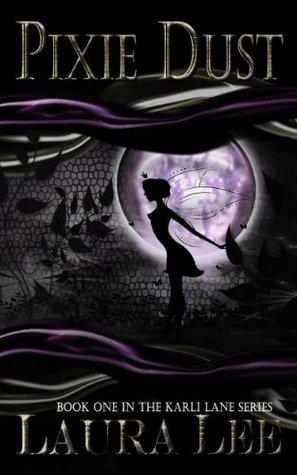
Pixie Dust

I picked up Laura Lee‘s Pixie Dust from the Amazon free list. At the time of posting, it was still free (probably permafree).

Description from Goodreads:
*A lonesome fairy with no clue how to wield her powerful magic.

*A ruggedly handsome warlock torn between his past and his present.

*A five hundred year old, sinfully sexy vampire who’s obsessed with solving the mystery of a particularly interesting bartender. 

Karli Lane is the only fairy left on the planet. Vampires had driven her race to near extinction, causing the others to return to their homeland over twenty years ago. Orphaned at a young age, she was forced to hide her identity in a world full of exposed supernaturals. 

Facing her upcoming immortality, her life has become a complicated mess. A new employer and a gruesome murder bring two incredibly complex men into her life, making matters worse. She finds herself riding a non-stop emotional roller coaster while trying to figure out who she is, how to control her powers, and most importantly, how to stay alive.

Review:
Weak, very weak; that’s my assessment of this drivel. That’s right I said it. I usually try really hard not to say insulting things. I know it’s extremely hard to write even a weak book. I do. I’m sympathetic. But just about every aspect of this book and its main character grated on me.

Starting with the ridiculous attempt at regionally hip dialogue: “True dat, Bitches!” Ugh. This followed immediately by the cookie cutter caricature of a slutty BFF. I’m not slut shaming here. Eri seems really comfortable in her slut role, even giving instructions to dress sluttier, etc. More power to her. But as a character, she was beyond unidimensional. There simply wasn’t anything else to her (or anyone else).

Then the movie comparisons started…and never stopped. It’s a poor way to describe something or provide familiarity, but also a pet peeve of mine. Both because I no longer own a television or bother with Hollywood (so I often don’t get the references and kind of resent the assumption that everyone will) and because it dates a book quickly. Plus, it just clutters up the narrative.

Just about the time I’d ground my teeth and persuaded myself to stick with it. I was blindsided by a series of instant and baseless attitude and character changes. One second two characters are cocky and hating each-other, the next throwing themselves at one another in sexual heat, then suddenly all shy and hesitant. So, enemies to lovers to touchingly sweet love in about an hour. Oh, and this happened more than once.

About that touching, all consuming love…There were two of them, for starters. And while I love a little ménage here and there, this wasn’t that. It wasn’t even a love triangle. It was just two men who for no apparent reason suddenly fell madly in love with one woman (on sight), were willing to do anything for her, and apparently didn’t even mind the other. Hmm, I guess maybe that could have been a little further developed…maybe at all.

Even more confounding than the sudden, obsessive love of two sexy, powerful men who didn’t know her from Eve was the question of why/how the vampire managed to overcome the bloodlust that plagued EVERY VAMPIRE THROUGHOUT DOCUMENTED HISTORY as if it was nothing at all. No explanation provided or even attempted. And if that wasn’t enough to make me gnash my teeth, the question of why she would put herself into the position to find out he wasn’t going to kill her immediately is. Hello stupid!

But stupid was a running theme for her. For example, being a fairy is supposed to be some big secret she’s kept her whole life, but her slutty BFF knows and she’s only been Karli’s BFF for a year or so. Which means Karli couldn’t have waited long to tell her the oh-so-big secret. She then easily (accidentally) revealed herself by displaying her powers to someone she just met. Shortly thereafter, she walked into a possibly dangerous situation and orders 3 double shots of vodka. Guess being clear headed isn’t important or anything.

Could she really be that stupid? Yep, ’cause next Ms. Clutso sliced herself open in front of a vampire and let him lick it clean. (You know those vampires who almost exterminated her entire race for their blood, yeah, them.) Really. Not too careful, our MC. She basically approached Too Stupid To Live territory and camped out there.

Then there was the juvenile shouting, yelling, screaming, etc. Maybe this is just a symptom of the verbs the author chose to use, but it made everyone (but especially Karli) feel overly dramatic and tween-angsty. Especially since more often than not the circumstances didn’t call for all the extra emotion. For example, she Karli didn’t want to have a conversation with Vance (a perfectly reasonable one, BTW), so she screamed at him, slammed doors, tried to throw him out and eventually threw herself into idiotic danger with a smirk. Someone just go ahead and shoot this woman for me, please.

Add to all that the obvious attempts to add pointless titillation and I’m darned near toasted. As an example, one night after meeting Karli the detective asks her to accompany him to seek out a suspect (obviously proper police procedure, that). He then takes her to a sex-bar. This was pointless for anything but to showcase her apparent naiveté and allow for a whole boatload of sexual snippets. It was also almost too cliché (and over-used in PNR) to bear.

Plus, in an atmosphere of complete sexual nihilism there isn’t a single non-hetero act to be seen and the whole scene seemed oddly male-centric, making even the women seeking their own pleasure feel like sex workers instead of equal-part satyric. Seems unlikely and mildly insulting.

This theme of pointless titillation continued in the make out sessions that leapt out of no where, but never actually went anywhere. This irked the hell out of me because they were so jarring, but also because it made the book feel very stop-start. Not to mention there was a whole heck of a lot of internal monologue-like fantasies, posturing, and petting and NO ACTUAL SEX. Seriously?!

Then I had to tolerate all of Leo’s pet names: sweets, my sweet, dearest, my dear, love, my love, etc. (There were an endless supply of them.) This drives me crazy in general. I find them belittling. But here they were especially annoying since he and Karli had no relationship yet for him to so casually, use them. It felt false.

The writing itself was fine. I found it a little repetitive at times, as reader saw events and then characters relate that event to others. There were also a number of infodumps that made things feel clunky. But beyond my basic loathing for first person points of view the writing wasn’t too bad.

To wrap this sucker up, I disliked this book. I hated the main character. I found her a weepy, bratty, juvenile woman. I probably would have liked the men if they’d been developed at all and if I understood where their obsession for Karli came from. But they weren’t and I didn’t. But as much as I disliked it all, it’s almost all personal preference sorts of material. The nuts and bolts are there and another reader might (does, since there are plenty of great reviews of Pixie Dust out there) really enjoy it. Just not me, not me at all.
Book Review of Confessions of a Gourmand, or How to Cook a Dragon, by Tom Bruno

Confessions of a Gourmand

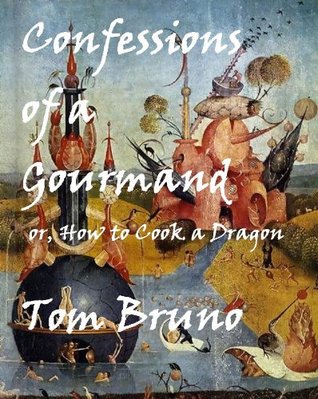
I downloaded Tom Bruno‘s foodie novel, Confessions of a Gourmand, or How to Cook a Dragon from the Amazon free list.

Description from Goodreads:
Van d’Allamitri is destined to become the most famous chef in all of the Three Continents– if only he can survive his childhood first! Son of a Shan-li restaurateur and a far trader from the great merchant city of Varo, young Van proves to be a natural talent in the kitchen, transforming the simplest of ingredients into delicious meals capable of enchanting the hearts of those who eat them. But when disaster strikes and the hated Varonians invade his sleepy home village, Van must choose between honoring the culinary traditions of his mother and following in the footsteps of his cosmopolitan but ne’er-do-well father.

Armed with his trusty chef’s knife and an enchanted wok containing the trapped soul of his ancestor, Van will cook many meals and face many dangers– from treacherous slavers and bloodthirsty mercenaries to the Gorgon Queens of Chocolate and their terrible reptilian pets– all the while unraveling the mystery of his father’s past and setting into motion an explosive confrontation between his people and a powerful empire. Confessions of a Gourmand is a novel about family, fantasy, and food set in a deliciously imagined world where dragons are not only real, but on the menu as well.

Review:
Most famous chef in the known world and his autobiography ends 17? I’m just akin’ ’cause, you know, seems maybe something got left out. No really, he’s writing this history as an ‘old man’ but it only covers birth to 17. Where are the next, oh, 50-80 years? Ok, I’m being overly critical and maybe a little priggish, but I’ve got a point right?

Now about those first 17 years…they’re pretty awesome. In the tradition of epic tales everywhere, Vin manages to heroically be in the right place at the right time (It’s actually often the wrong place at the wrong time, but who’s counting?) to make friends and influence people. By age six, he’s garnering the attention of kings, by mid-adolescence he’s wooing queens and rescuing the huddled masses and by 17 he’s changing local history and striking out on his own. Cool.

By 17 I’d paired combat boots with my minidress and silently dared my father to oppose my free expression of prescribed fashion anarchy. So, I’m duly impressed with Vin’s accomplishments. There were some definite, ‘well wasn’t that convenient’ moments, but they were generally overshadowed by my basic enjoyment of the tale and Vin’s voice.

The story is marinated…no, narrated in a marvellously conversational tone, by an eminently likeable main character. Vin’s willingness to admit to his own faults makes him hard to resist and Bruno’s ability to somehow thread Vin’s narrative with subtle emotional shifts made it feel real, despite it’ fantasy setting.

The book does drag in the middle. Counterintuitively, this is when Vin ages past his culture’s version of childhood, leaves home for the first time, travels, discovers women, etc. You would think this would be where the book picks up. But no, I found his six-year-old self more interesting than his older self (at least until the very end, when the pace accelerated again).

Part of the reason is that as a child he didn’t have enough life behind him to allow for flashbacks. As he aged, these flashbacks became more common and (I found) distracting. Especially as they were often interspersed with other narratives, going back and forward between two memories/tales with no indication or visual transition. Meaning you didn’t realise you’d shifted from the primary event to the secondary event until a sentence to two into the new paragraph. Annoying.

Another reason is the inclusion of at least one lengthy recipe, if not an entire multi-course menu description in each chapter. I found it stifling by the latter half of the book. Both because the pattern became so apparent and because as he aged his cooking grew more complex and took more time to explain.

However, even throughout the slow bits I found plenty to appreciate. The almost recognisable cultures Vin describes (certainly I saw China and Italy, possibly Japan and Spain) were interesting, while the completely imaginary ones (the Gorgon queen of Chocolate, for example) tickled my fantasy-fancy. Because lets not pretend that Vin’s focus on food wasn’t also a convenient hook to discuss the politics, histories, mores, habits and customs of the different peoples’ haute cuisine he cooks so well. (And all of it is surprisingly well thought out.) All this before I even scratch the surface of dragons, wyrms, dinosaurs, cyclops, shark-shifters, etc. One is never sure where myth leaves off and reality begins, but one always enjoys the story.

My one main complaint about the book, however, is that Vin’s age is largely indeterminate until very late in the game (like 95% through). This is both a symptom of and a cause of the fact that you’re never sure how much time is or has passed. At one point, I thought him 8-9 years old only to have him referred to as a child and taken as a lover within the same few pages. He eventually refers to his  ‘not yet 16 year old self.’ Would that make him 15? I guess that’s better than the 12-13 I’d guestimated when It became apparent he was no longer a child-child and was being taken to the bed of a significantly older woman.

Either way he’s under age and having sex. This didn’t particularly bother me. I’m flexible enough to roll with cultural difference concerning age of adulthood/consent and there is no graphic sex anyway, but some people might be bothered. Me? I was just annoyed because I didn’t know if I should be picturing a short, juvenile boy with a sparklingly clear voice or a gangly, gravel-voiced adolescent. These things are important to a visually prone reader!

All in all, I’m closing this book happy. I thoroughly enjoyed following Vin’s adventure and will happily pick up another of Bruno’s works.

Mere Mortal

Book Review of Mere Mortal, by Katie Roman

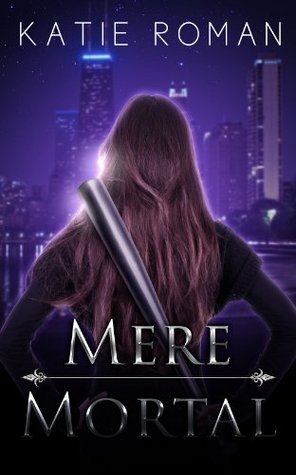
Mere MortalI grabbed a copy of Katie Roman‘s Mere Mortal from the Amazon free list.

Description from Goodreads:
Samantha Dunmore would be thrilled to live quietly with her dog. However, working as a social worker for vampires makes life anything but. When an ancient vampire brings trouble right to Samantha’s doorstep she must step out of her quiet life and into a world of villainous vampires, werewolves with hero complexes, and witches out to make mischief. Armed with attitude and a blessed baseball bat Samantha decides to get her life back to normal, or as normal as she can.

Review:
I’d call this an all right read, not horrible but not spectacular either. It’s a shame, too. Because, I think it really could have been, had the author not tried so hard to add so many literary ‘must haves,’ that the book just didn’t need and done a little more editing.

What I did like: I liked Samantha. She was smart and relatively savvy in the end. (I spent a while thinking she must be a bit dim to go along with everything and not report anything, but as she figures it out so did I and she wasn’t stupid.) It was a pleasant surprise. I liked some of the cheeky dialogue and that the closest thing the book had to a hero wasn’t allowed to sweep in and solve all her problems. I also liked the basic premise of the world everything occurs in.

What I didn’t like: To put it bluntly, it felt like the book didn’t actually have a point. Samantha runs around randomly getting attacked, then the book ends. The issue with the item causing all the ruckus is never solved. In fact, its never even addressed, which left me wondering why everything suddenly settled down. Or looking at it from the other end, if it was so easily settled why make such a big deal of it to begin with? Plus, if the baddie could so easily get someone into her office, as he did, why not just do that instead of harassing Samantha at all?

There was also a weak attempt at a romance that I could have done without, as it contributed nothing to the story. Even worse, it was essentially unsupported. I suppose the reader is supposed to assume it’s been simmering for a while, but that information isn’t actually there. The uncomfortable assumption is just the only way to make it work when it suddenly shows up.

This is one of those ‘must haves’ I referred to. The romance was not necessary for the progression of the plot; it distracted from the main mystery, wasn’t really fleshed out enough to be satisfying and, in the end, just became a little annoying in its half-assedness. It felt very much like the author added it in to make the book appeal to a broader or certain audience, not because it was a legitimate part of her story. 

Having said all that, it was still a relatively amusing read and I did enjoy the experience.