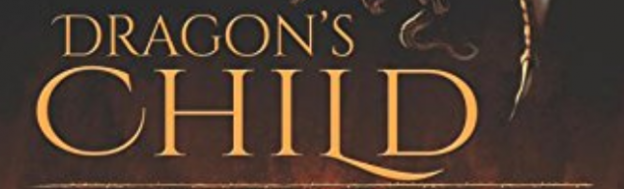
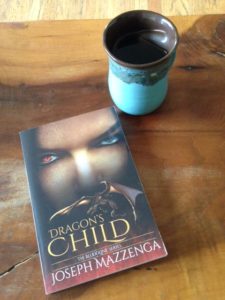
 Joseph Mazzenga sent me a copy of his novel, Dragon’s Child.
Description from Goodreads:
The year is 2188. A virus creeps through DownCity. Swift. Deadly. The disease is bred through a growing gang of vampire monsters – Infectids who nosh on human hosts both to feed and spread their viral control over the city.
Trace Alden was a cop until he lost his beloved Gloria to the Infectids. Drinking to borderline insanity, his only salvation was to become a Hunter – Neither bounty hunter, nor cop, but a licensed killer. Alden works above the law to eradicate the now organized group of Infectids that look to rid the world of the human pollutant. He must not only fight the terrors in the city but his horrors from within.
Goji has wandered through mystic memories all of her 18 years of life. Barely controlling powers she has yet to understand, she rules the alleys taking on as many monsters with her special abilities as she can. Her only link to her past and who she really is are the brief, ancient memories that come to her in her sleep. Haunted by messages she cannot interpret, Goji’s biggest struggle is to quell the monster inside of her. Unwillingly paired, the aging ex-cop and the young vigilante are sent to end the diseased scourge and ancient monster that leads them. If the demons on the street don’t get them, their demons from within will.
Review:
Oh man, I hate to do this. This book doesn’t have many reviews and I hate to be the first bad one (and a long, editorial, somewhat ranty one at that), but I can’t give this a good review. First and foremost, I don’t see anything labeling the copy I have as an ARC, however it really does need more editing. More copy edits to catch grammar and homophone errors. But also content edits to deal with consistency issues, the timeline and just bring the story together. Because here’s the thing, there’s a cool idea in Dragon’s Child and what could be some cool characters. But NONE of it is shining.
I spent a lot of the book confused. There’s no world-development. There’s no character growth. The timeline is muddled, possibly purposefully vague. People show up, disappear and show up hundreds (thousands?) of years later, only to die pointlessly. There is no sense of what characters who have lived hundreds (thousands?) of years have done that whole time. The reader is given one heroine (who you think is a main character) and then suddenly, half-way through the book, we’re given a second. I don’t know if the dragon or the rider was the main villain. I don’t know if the rider was human, and if not what he was. I don’t know if the dragons were born or summoned, and if summoned, from where. I don’t know what their motivation was. I don’t know how the ‘vampires’ were created. I often didn’t know who was speaking. I just spent a lot of the book going, “What” and “Why.”
The cover is awesome and the writing is ok, if a bit overwrought. Though, the referencing of people as ‘the cop,’ ‘the ex-cop’ (which confusingly are the same person), ‘the girl,’ etc really distanced me from the characters and made it hard to connect with them.
Note: most people can stop reading now. The rest is my ranty bit and will likely make this review seem more brutal than intended. Just call it my opinion piece. There’s also a spoiler in it.
I personally had some gender complaints. (But I often do when male authors write female warriors.) And I’ll admit up front that this is something that I am extra sensitive to. So, it might not be an issue for everyone.
First off, the whole she-knight thing, occasionally she-warrior. It was perfectly obvious she was female, so why did she have to be a she-knight, instead of just a knight. (And I won’t even ask if the plains village had an aristocracy that bestowed knighthood. I’ll let that one go.) Why hyphenate her and make her separate and different from any other knight? Plus, it means so many sentence that referenced her ended up with two shes, as in “She was a she-knight.” It’s so repetitive and annoying.
Then you have the two dragons, one a male that is goodness personified and, more importantly for my point, has agency. While the female one is evil and enslaved, possibly willingly, to a man. All infectids seemed to be male, but when they attacked people to eat/rape (this was often conflated) they only seemed to choose females. (Though there were dead men about, their living terror never seemed to be shown.) All police officers were male. Every single female side character was incidental and every single one died, none were developed beyond a name.
The hero’s wife served no purpose but to die and give the hero motivation. She had no character of her own. When the heroines fought, their male opponents often threw the threat of rape at them, but never at the hero. Who knew morally debased, evil personified stuck so staunchly to heterosexual norms? I don’t think they would, I think authors just forget that it isn’t just women who can be victimized in this way.
My point is that, despite having two heroines, the book is written to feel very male. The gaze is male, the voice is male, the hero is a lot more competent, even though the heroines should have had hundreds (thousands?) of years to learn and grow. Even in the final fight, it wasn’t the heroine—who supposedly lived hundreds (thousands?) of years just to defeat this particular evil—who saved the day. It was the main character, who I’ve decided is Trace, even if the book covers hundreds (thousands?) of years of the female characters’ lives and therefore should focus on them. Because apparently hundreds (thousands?) of years of female life and sacrifice isn’t as important as a man’s 40ish years. That’s how the book <i>feels</i>. I’m not claiming intent on the authors part.
In fact, I really think Mazzenga intended Goji to be the main character. Claiming a book is disconcertingly male wouldn’t be an issue if I felt that’s how it was meant to be. Men deserve books directed at them too. But the whole plot points to Goji, suggests that she should the main character. But the book’s focus is unwaveringly on Trace. (So, even if they were meant to share the spotlight, it’s still not working.)
Unfortunately I feel this is simply a failure of the writing. Not to go all Feminist, but maybe even the effect of a man trying to write a book about a woman while living in a male dominated world. He didn’t seem able to force himself to take his eye off the hero long enough to truly develop the heroine I think he intended to be the focal point of the book. I suppose the book is just traditional fantasy in this regard. But it’s this seemingly accidental, oblivious nature of it that bothers me.
If this author sent this book to an editor and took a conscious look at his gender representation, I think it could be something special. But it’s not there yet. Oh well, I’ll put it out in my Free Little Library. Maybe it’ll be picked up by someone who loves it. I’m sorry I couldn’t love it more myself.
 I received an audible copy of Magic Wand Ranch from the author, Caroline Mickelson. It’s narrated by Leonor A. Woodworth.
 I won an Audible copy of