Tag Archives: book review

Book Review: Shadowcursed, by Gelo R. Fleisher

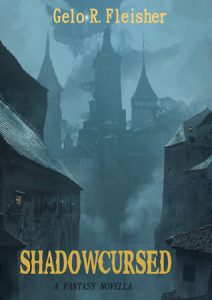
shadowcursed cover

About the book:

Bolen is a thief, plying his trade under the spires of an ancient and sprawling city. Worried that he’s growing too old, Bolen has lined up a risky job, just to prove that he can still pull one off.

Tonight, he’s going to break into a nobleman’s vault and help himself to its contents. What he doesn’t know is that inside is the key to a secret as old as the city itself.

Kings have killed for it, demons have coveted it, priests have prayed for it, and in a few moments it will be in his hands. And when it is, the adventure of his life will begin.

Review:

I was really quite impressed by the contemplative nature of this novella. It’s a little repetitive, I’ll admit. But I really appreciated seeing men long accustomed to atrocities learn what it means to face their own inner light, even if they have to fight the physical embodiment of their darkness first—well written, with engaging characters and HEA of sorts. This isn’t tweeny, sparkly fantasy. I’d recommend it for fans of eerie, thought-provoking fantasy instead.

Book Review of Home the Hard Way, by Z. A. Maxfield

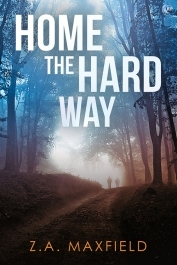
Home the Hard Way

The nice folks over at Netgalley sent me an ARC of Home the Hard Way, by Z. A. Maxfield.

Description from Goodreads:
Dare Buckley has come home—or at least, he’s come back to Palladian, the small town he left as a teenager. After a major lapse in judgment forced him to resign from the Seattle PD, Palladian is the only place that’ll hire him. There’s one benefit to hitting rock bottom, though: the chance to investigate the mystery of his father’s suicide.

Dare also gets to reacquaint himself with Finn Fowler, whose childhood hero worship ended in uncomfortable silence when Dare moved away. But Finn isn’t the same little kid Dare once protected. He’s grown into an attractive, enigmatic stranger who neither wants nor needs what Dare has to offer.

In fact, Dare soon realizes that Finn’s keeping secrets—his own and the town’s. And he doesn’t seem to care that Dare needs answers. The atmosphere in Palladian, like its namesake river, appears placid, but dark currents churn underneath. When danger closes in, Dare must pit his ingenuity against his heart, and find his way home the hard way.

Review:
I’m having a hard time deciding how I feel about this book. I finished it last night, with time to review it, but waited until today in order to consider my own response to it. You see, I can’t decide if I didn’t like certain aspects of the story full stop or if I just didn’t like that it wasn’t the story I wanted it to be (if that distinction makes any sense outside of my head). 

Before I talk more about that let me add here that I like erotica. Not that I would qualify this as erotica, there isn’t that much sex in it. But my point is that I have no problem with sex in books. I like a lot of m/m romances. I also like finding a little surprise kink thrown into either one. So, my complaint isn’t based just on not liking D/s, BDSM, rope and/or pain play in the book. (Though, I have to admit, anytime a character refers to something by its name, like ‘pain play,’ it feels too proper to be realistic to me. It rings the same cringe-bell as stiff dialogue in my head. But that’s a whole ‘nother matter altogether.)

Having said all that, I didn’t like the BDSM, etc. aspect of this book. I think it was probably well written; that’s not my complaint. And it was kinda hot; that’s not my beef either. It just didn’t feel natural in the story. This is the first Z. A. Maxfield book I’ve ever read, so I’m not coming from a place of comparative knowledge. But to me it FELT like it was all thrown in just to catch readers from the current D/s popularity wave. I don’t know if it really was, but that’s how it felt to me.

You see, Dare comes home to Palladian with no discernible interest in being dominated in any fashion. Doesn’t even seem to be consciously aware of the lifestyle. But on meeting up with Finn he immediately starts wanting things he’s never wanted before. He allows Finn control he’d never previously even considered giving up and he does it with no discussion, explanation or even verbal request (from either party). Now, consent is very clearly established, as are stop words and such. I don’t mean anything like that. I just mean there must have been some psychic communication going on for Finn to know what Dare wanted and for Dare to know Finn could/would provide it, especially on Dare’s part.

I did like Dare and Finn. Don’t get me wrong. I liked them. I just kept thinking that the things they were doing didn’t fit the otherwise sweet romance that was trying desperately to establish itself. This is also were my ‘did I just not like it’ or ‘did I not like that the blurb sent me in expecting something else’ internal debate comes in. Either way, it was jarring to me. 

Then there was the whole Fraser twist. Surprisingly, I also like Fraser. I had fewer problems with he and Finn’s activities than Finn and Dare’s. It felt more natural there, maybe because it had had years to develop. However, unless there is going to be a sequel that deals with Fraser and his issues I’d have to call it a giant loose end. 

I also liked the, I believe the phrase is penetration politics. Dare is your average hulking police alpha (as is Fraser), Finn is as you would expect. He’s smaller, finer boned, prettier, gayer (or at least more openly so). Based on m/m norms you would expect Dare & Fraser to top almost exclusively. It was nice to see this trope played with.

The mystery was a good one. It wasn’t too hard to figure the historic aspect of it out. It was pretty obvious, actually. But that obviousness just made the part happening in ‘real-time’ more interesting because you had this tantalising part of the puzzle that Dare didn’t. 

The writing and editing were both pretty good. I was a bit bothered by all the full names. Palladian is meant to be a pretty small town and everyone’s supposed to have known each other since childhood. So I can’t imagine they’d so often need a full name to identify someone. I also thought the author had a few catchall phrases she repeated (the plug & socket comparison, for example). But really these are minuscule complaints in the grand scheme of things. 

I’m feeling fairly torn about how I feel or how I want to rate this book. So, I’m splitting the difference with a 3 and a bit.

Review of Indigo & Iris (Indigo Lewis #1), by C.M. Stunich

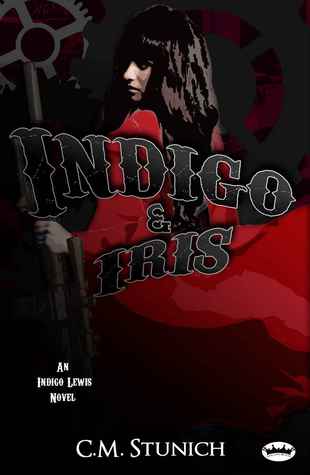
Indigo & Iris

Early last year, I grabbed C. M. Stunich‘s Indigo & Iris from the Amazon free list.

Description from Goodreads:
“If I had known last week that I would be sitting in the middle of a Dr. Seuss/Wild, Wild West hybrid nightmare, I would’ve brought more booze.”

Rule One: Gold protects but doesn’t prevent.
Rule Number One Hundred and Eighteen: Do not discredit any information for all things are, in time, inherently useful.
Rule One Hundred and Eighty Seven: Remember the Rules.

They sound more like fortune cookies than bits of advice, but Indigo Lewis is going to have to get real used to ’em if she wants to survive. After eight years on the lam, her maniacal twin sister has finally caught up with Indigo and taken away everything she’s finally built for herself. On the coattails of that tragedy comes Lynx, the man with the goofy grin and the gold epaulettes, who brings with him a train that travels without tracks and an arsenal of weapons that shouldn’t reasonably exist. And all of it for a broken spyglass. Indigo thought she’d seen it all. She was wrong.

Review:
Ok, I’m just gonna go ahead and start off with the same pissed off rant I’ve had about a million times now. (I’m not sure when this became an acceptable norm, but I wish it hadn’t.) Books should consist of at least three important things: a beginning, middle and END. Yes, an end is a required part of a book. Why then, have I read so many novels that don’t have one? Angry, it makes me angry. It makes me want to write off otherwise perfectly acceptable authors out of pure spite. (And Stunich can sure write.) Can’t bother to give me, the reader, an ending? Well, I can’t be bothered to start any more of your books. BAM

This is especially pertinent when speaking about a book like Indigo & Iris that starts out somewhere in the middle, with a whole lot of unsaid history, a confused MC and even more confused reader. For at least the first 50% of the book you have no idea what is going on (and very little even after that). This book is literally like running around with the Mad Hatter and his dozy door mouse. There’s even a lot of tea. But it’s random, unpredictable and makes little sense. However, it does manage to inspire confidence in the reader that at some point it will.

It’s a fun read. Indigo is pretty badass, in a cranky, bitchy kind of way. Lynx is hot stuff, even if he is crazy as all get out. It even manages to avoid falling into unintended YAness. (A trap a lot of books of similar intent seem stumble into.) It’s an adult read, full of cursing and sex jokes. It’s fun. But their vivacious tête-à-têtes and the steampunk descriptions are all the book manages to ride on. What plot there is, is too hidden to even guess at. And believe me, as interesting as the machinery and the characters’ repartee is, it gets old quickly. As did Indigo punching Lynx in the face and pulling guns on him constantly. It was funny for a while, but when it (and little else) happened again and again it lost quite a bit of its lustre.

Then, when it all just starts (and I mean JUST starts) to come together in something resembling a recognisable story arc the book ends. Essentially, I was lost in the beginning but enjoyed the characters enough to keep reading. I then lost patience with the whole thing and wished for a quick end. But it eventually started to pick back up and I became invested again, only to have that relit spark immediately doused by an untimely ending. It’s like an emotional sucker punch. Ha, gotcha!

I’d love to know what happens next. But I just can’t be bothered, because you know what, I’d bet top dollar that if this book ends on a precipitous cliffhanger with no discernible conclusion the next one will too and I’m just not doing that to myself. (You see authors; this is the sort of expectation you’re creating in your readers with all these serials.)

It’s worth noting too that, while well written, there were a few editorial mishaps and a little more attention could have been paid to both textual and digital formatting. There were a number of places where hard returns were missing, creating confusion in terms of who is speaking or reacting to the statement and the font changed sizes several times in the course of the book.