Category Archives: books/book review

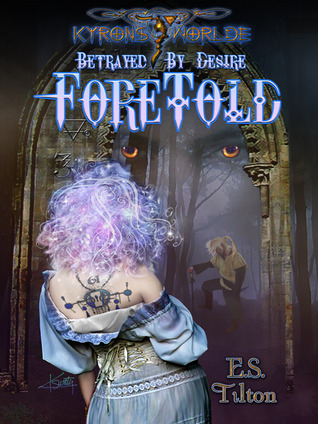
Betrayed By Desire

Book Review of Betrayed By Desire (Kyron’s Worlde: Foretold #1), by E.S. Tilton

Betrayed by Desire: ForetoldI grabbed Betrayed By Desire, by E.S. Tilton from the Amazon free list.

Description from Goodreads:
Llayentia’s outcast psychics foresee destruction at the finish of nearly all time streams. Grim with determination, The Seven plot to protect their world…at all cost.

Kyra Atar is one irresistible assassin. And she knows it. Wielding freni-kyn illusions, she slips into the persona of anyone she wants…with one exception…herself.

Recruited into a life he despises, illegal half-breed Tahrek Mitan shifts from assignment to assignment without hope of relief. His newest job is simple. Betray and execute a fellow assassin…Kyra.

While struggling for survival the two must defeat the deadliest stalker of all: forbidden desire.

Review:
This was an entertaining enough read. It has an interesting world, interesting species, and an interesting plot. After a disjointed and confusing start, I spent the first half of the book really enjoying myself. However, around the 65% mark the book started to drift and I started to lose interest.

The issue is that, while the book started out with assassins doing cool assassin things, it then hit a strange domestic plateau in which very little relevant to the preceding story happened—reconnecting with friends, learning about herbs, setting up trading routes, etc. Not only did this take up a lot of time in an already gangly and too long story, I was left thinking, ‘What happened to the book I was reading? This doesn’t seem to be the same one.’ And it never got back to the first one. The book has a very abrupt ending, leaving all the threads open (that’s right, nothing concludes) and the story at the end feels very different from the one that began.

You see, this book takes the long view of history, which seems to give it permission to diverge from its primary plot-line regularly. I wish it hadn’t, but that’s just me. To elaborate, the book has five prologues. (Don’t ask me why, I don’t know either, but I’d have been lost if I hadn’t read them.) Between prologues four and five, 253 years passed. Then, between the end of prologue 5 and beginning of chapter one, 2,658 years passed!

Considering the length of time covered in the first 10% of the book, it probably shouldn’t be surprising that the remaining story couldn’t be contained within one volume. However, it seemed to me that it could have been condensed a bit. Long, LONG passages were dedicated to comparatively unimportant things, bonding ceremony preparations or dreams, for example, and most of these were contained within the not primary plot portions of the book.

My point is that in a story that already covered thousands of years and looks to take many more years to conclude, such forays into detailed mundanity need to either be curtailed or readers need to understand in advance that this is going to be a very long series, with each book containing only a fragment of the larger story but a lot of detail on the rest of the characters’ lives. Expect no closure here.

As an example, the seven children being bred in prologue one never appear anywhere in the book, or at least nowhere that the reader knows that they are one of the seven. This whole prologue seems to be a set up for something that will happen in some future book. There were a number of small things like this. The bit about a man killing women who remind him of Kyra, is another example. He was never mentioned after his brief 3-4 page blip into existence. (Though reading the blurb of book two, I bet he shows up there.) But scattered through the book were random, anchorless reveals that serve no apparent purpose.
Now, I must admit that I loved Tahrek. He’s broken, but extremely loyal and caring, not to mention badass. I melted a bit every-time he spoke. I liked Kyra, but I didn’t love her. She seemed inconsistent to me. One minute throwing herself at Tahrek sexually, the next accusing him of taking advantage of her. For half the book, she was a standoffish sort, the last half a giggling, hugging sort.

I think something else that contributed to the different feel of the first and second half of the book was that toward the end, once the Kyra and Tahrek were comfortable with one another, they started using names a lot. This often breaks the flow of dialogue and feels unnatural. I didn’t notice this pesky problem in the beginning, but I found myself gritting my teeth with it at the end.

With the exception of the too frequent names, I thought most of the actual writing was perfectly passable. The POVs jumped around a lot, but it wasn’t too disruptive. There were some random mysterious messages in a rough-paper-like graphic that felt really gimmicky and out of place. Plus, whomever the communications are between is never directly addressed, leaving the reader to wonder what they’re all about. (One more reveal for some future book maybe.)

So, in the end, I imagine this will be a really interesting SERIES, but as an individual book, I was disappointed. There is just so much set up for a really long and detailed story that I feel like someone handed me the first 300 pages of a 4,000 page epic. But if you’re willing to dedicate yourself to a lengthy series of reads, this one might be worth picking up.

Fires of Man

Book Review of Fires of Man (Psionic Earth, #1), by Dan Levinson

Fires of ManAuthor, Dan Levinson sent me an e-ARC of Fires of Man (due out this spring).

Description from Goodreads:
In a world where a gifted few can manipulate reality with their minds, two great nations—Calchis and Orion—employ these psionic powers in a covert war for global superiority. In the heart of Calchis, a powerful young psion named Aaron Waverly is kidnapped, and forcibly conscripted. To the north, in the capital, a plan is hatched to decimate Orion, to be carried out by the ruthless operative known only as “Agent.” In Orion, fresh recruit Stockton Finn comes to terms with his incredible new powers, and learns firsthand how dangerous they can be. Meanwhile, officers Nyne Allen and Kay Barrett navigate the aftermath of their shattered love affair, oblivious to the fact that Calchis draws ever closer to destroying the tenuous peace. Finally, in the arctic land of Zenith, Calchan archaeologist Faith Santia unearths a millennia-old ruin. This lost temple might just hold the hidden history of psionic powers, as well as hints of a deeper mystery . . . that could shake the foundations of all mankind.

Review:
Fires of Man is set in an alternative Earth, in and alternative 2012. This made for an interesting, if occasionally jarring, mix of the new and exciting with the familiar and mundane. For example, characters practiced their amazing Psionic powers and then sat down with a beer and the TV remote. Plus, all of the place names are just a little off from being recognisable. It’s almost the Earth we know, but not quite. It took me a while to get used to it.

There is a lot I could say about this book, but I’ll start by saying the writing is excellent. The dialogue feels realistic and it’s quite well edited. There are some really thought provoking subtexts too—the horrors of war, the transition from boy to man to soldier, the value of morals when confronted with the reality of kill or be killed, love, etc. But in the end it’s really just the beginning of something.

This is definitely, DEFINITELY not a stand alone book. Nothing concludes and ALL of the threads are left hanging. In fact, I might call this whole book a set up for the actual story to come, because it’s not so much about anything that happens as it is about getting to know the people who will apparently be important at some future point.

This isn’t to say nothing happens, a lot does. Nor is it to say it wasn’t enjoyable. It was. Those characters are all interesting and highly engageable. The world and it’s politics is interesting and the hints at the final shebang looks intriguing. But there is a surprisingly long character list, with all of them being given equal time. I’d have a hard time pinpointing a single one as the MAIN character at this point. Additionally, few of them cross paths at any time in the novel. So, in a way, this was really 5 or 6 stories in one book. The reader has to take it on faith that eventually in some future book they will all play a significant role in some singular something.

I enjoyed the writing a lot, heck I enjoyed the book. But if I had it to read again I wouldn’t bother until there was a sequel or two available, because I’m done now and I know half a story (maybe less if this is going to be a longer series). This annoys me. However, I am not so oblivious to the basic realities of publishing that I don’t recognise that at 400 pages the book essentially reached its maximum allowable length and had to be broken up.

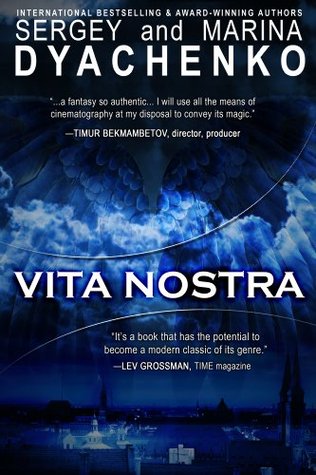
Vita Nostra

Book Review of Vita Nostra (Метаморфозы #1), by Maryna & Sergey Dyachenko

Vita NostraI grabbed Vita Nostra, by husband/wife team Maryna and Sergey Dyachenko from the Amazon free list.

Description from Goodreads:
The heroine of the novel has been forced into a seemingly inconceivable situation. Against her will, she must enter the Institute of Special Technologies. A slightest misstep or failure at school—and the students’ loved ones pay a price. Governed by fear and coercion, Sasha will learn the meaning of the phrase “In the beginning was the word …”

Review:
Oh, this was a wonderful read—slow and meticulous, with a tendency to make my brain quiver, but wonderful all the same. There is just so much atmosphere to it. It’s easy to follow why Sasha does what she does, even though it should defy all logic. She’s also a really relatable character, even in such an alien environment. There were some interesting side characters, who all played important roles and the story kept me on the edge of my seat. 

I would have liked to know a bit more about the other students’ experiences, to see how they differed from Sasha’s. But I understand that it would have been difficult to do, since the POV was fairly consistently focused on Sasha and it would have felt awkward to suddenly shift. 

Now, this isn’t a book where the answers are easily given to you. You have to do a little mental work to figure things out. As an example, after finishing the book I went straight to bed. (I’d stayed up to read it.) I crawled under the blankets thinking, ‘but I don’t really know exactly what happened. I understand the broad strokes of it, but was it a happy ending?’ I was a little distressed by this. But as I put it out of my conscious mind and attempted sleep, the subtler details rose to the surface and I realised, yes, I do know exactly what happened. But it took the mental sifting for me to grasp it. I love books that do that!

At times the narrative got a little clunky or staccato, but I think this was the result of the translation. (Not to suggest the narrator did anything but a great job. I think sometimes there just might not be a concise way to express in English the original Russian thought.) For the most part however, it read smoothly and was surprisingly well edited. 

It’s my understanding that this book is quite famous in Russia and I can see why. I strongly suggest picking it up. It’s a great read. I know I’ll be on the lookout for more of Maryna & Serhiy Dyachenko’s works. It’s just a shame so few of them have been translated. If anyone has a petition going around begging for more, please send it my way so I can sign.