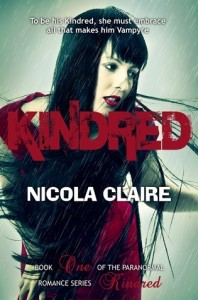
 I grabbed Nicola Claire‘s PNR, Kindred from the Amazon free list. It’s still free. I suspect it’s perma-free.
Description from Goodreads:
Vampires, shape shifters, ghouls and magic users abound in a world where the Norms, (those humans without paranormal abilities) are ignorant of the creatures of the night and the supernatural species that live alongside them.
Lucinda Monk is a bank teller by day and a vampire hunter by night, but she wasn’t always a part of this world. Thrown into a heady mix of powerful people and sensual beings, she’s had to find her way practically blindfolded in amongst the creatures of the night. But she’s a capable and realistic kind of girl. Her motto: never show fear. But, there’s something different about Lucinda, something those creatures she hunts, want. In order to stay one step ahead of the enemy she has to let the enemy in. In all his compelling, seductive and delicious ways. Sleeping with the enemy has never meant so much before. But, can she trust him?
From the urban streets of the city, to the dark alleys and sinful bars that promise a wickedness a girl from the farm has never before been exposed to, Lucinda gets drawn irreversibly into the dark side of life. And if the Master of the City had his way, she would always be his. For eternity.
Review:
This is feeling like it’s gonna be a long one and may contain mild spoilers.
To start off with, this is very, VERY similar to the Anita Blake series. The heroine, Lucinda, is a vampire hunter instead of a necromancer who hunts vampires (Anita), but she has a very similar attitude. Lucinda’s best friend is a shifter, much like Richard is in the A. B. series and there are hints of a pretty powerful love triangle (One would hope not an actual trifecta. That really would be far too much to chalk up to coincidence), but it’s Michel’s similarities to Jean Claude that really raised my eyebrows.
Jean Claude (from A.B.) is an ill-defined master vampire, whatever that is. Michel (from Kindred) is an ill-defined master vampire, whatever that is. J.C. is the master of his city. Michel is the master of his city. Both are tall. Both have dark, longish hair and blue eyes. Both own/manage nightclubs. J.C. is 400-600 years old and powerful. Michel is 500 years old and powerful. Both are French (both from peasant families). Both are fashion conscious. Both were changed to vampires in their early thirties—J.C. at 30, Michel at 32. Both have voices that are described as having a physical sensory response in the heroine, strokes their skin and such. Both visit their heroines in her dreams. Both use a little French pet name for their romantic interest—J.C. ma petite and/or ma cherie, Michel ma douce and/or ma belle. They’re both arrogant and act/speak in very similar manners. Removed from context and set side by side, I literally wouldn’t be able to tell one from the other.
Given the similarities, I suppose I can say with complete confidence that if you liked Anita Blake, Vampire Hunter you’ll like Kindred. Personally, I found both of them fairly so-so. Not horrible, but I didn’t fall in love either. In the case of Kindred I found that I basically enjoyed it, but had some fairly serious complaints too.
To start with the positive, I like that Lucinda was an unapologeticly sexual woman, without any kind of fuss needing to be made about virginity or lack of experience. It just wasn’t mentioned at all and at 24 year old, it doesn’t need to be. I really appreciated that. So often, PNR heroines are made out to be chaste maidens and the reader has to sit through endless scenes of mental agony over the consequences of having sex. I liked that this book skipped all that. She had sex, but there wasn’t the need to dramatise it.
I also liked that the basic vampire psyche was fairly well thought out and thoroughly explained. It really gave the reader a good understanding of their actions, especially when dealing with instinctual responses to things.
Most of the time, I also liked Lucinda and Michel. Lucinda was fairly sharp and truly brave and Michel could be really sexy sometimes. I didn’t always like them though. Lucinda seemed to constantly be crying over some little thing or another. It made her seem weak. And Michel was a jackass as often as he was a sweetheart.
Lastly, I liked that the book was set in Auckland, New Zealand. The US, followed by the UK are the settings for the vast majority of the genre. It was refreshing to find myself somewhere new, with new terminology, cultural norms, etc.
Next, to move on to things that irritated me; I’ll start with the minor stuff. The whole vampire/vampire hunter partnership made no sense to me. Michel spoke of it as if the vampires and the hunters had come to an agreement, or an ‘accord’ probably, and agreed to it. But the symptoms and consequences are biological. So how does that work then?
What’s more, if it is all based on some past agreement between the species, even one that later somehow became engrained in the biology of hunters and vampires, how can a hunter be forced into it? How, exactly, the bonding takes place was never fully explained. There was a social ceremony but it wasn’t clear which aspect of it actual initiates the binding. I was left confused about one of the most important aspects of the plot.
Similarly, the whole dream walking made little sense either. She could physically, but invisibly, appear elsewhere with tools she didn’t have with her where her physical body was and actually affect physical reality. Seems unlikely, but more importantly how could that happen?
Next, and I can’t believe I’m saying this; it’s completely opposite of what I’m usually harping on about—books that end without conclusions—but IMO this book should have ended at about 45% and the remaining 50% been a separate book. (The last 5% is bonus material.)
There is a fairly dramatic event around that time that then requires the introduction of a whole new threat (plot) and reads as a separate, but related novel. There are even the occasional recap passages one finds in sequels to remind them of what happened in previous books. The shift felt abrupt. I might not even mention it if this was a stand-alone book. I would just assume the author was trying to keep the whole story in one text and appreciate the effort. But there are 7 subsequent books in the Kindred series, so why not just break it up and make it a 9 book series instead?
Lastly, for the small irritants, there are a series of deus ex machina events. These always annoy me. She repeatedly saves the day, or at least the lives in a situation, by pulling some unknown ultra-power out of her back pocket without knowing how or even that she was capable. These powers weren’t supposed to have manifested yet, but the miraculously do whenever she needs them. That always strikes me as weak.
Now, to move on to the (admittedly vague) major thing that made me grind my teeth. Lucinda was demonstrably powerless. Sure she pulled out the superpowers when need be, but I’m speaking of social and interpersonal power, not magic or fighting skill power.
For all the times she went on and on about equality, her wants, needs and desires were walked over repeatedly. Even her own emotions were manipulated by a variety of male characters. Often the reader would be told something along the lines of, Lucinda didn’t want to feel this way or reciprocate the lust, but her hands/mind/mouth/etc had a mind of their own. It was as if she had no defence against the men’s overpowering presence or that as a woman she had no control over her own sexual responses. God, women have been shoved in that box for generations and I still hate it.
And this manipulation wasn’t just done with vampire super mind control (you know glaze, glamour, rolled mind, etc) but by the fact that she was repeatedly distracted from justifiable anger by giving in to sexual desire when angry, or even worse regretted and cried, then apologised for her own feelings or appropriate retaliation for offences. Why should she have to do this? Men in this book were allowed to get angry, stay angry and react in anger. Lucinda was NEVER allowed this response.
Women just aren’t supposed to do that…not good girls anyway. We’ve all heard some version of it, ‘suck it up honey let the men handle it. They obviously know better than you, even if it makes you want to swallow your own teeth.’
The message became obviously one of secondary status. The problem is that it was written as if to suggest she wasn’t, but actions speak louder than words, as they say, and Lucinda was not the one able to cause change in herself or others, she was only the recipient of it and she then wasn’t even allowed to be angry about it.
As an example, Michel denied her demand to see Rick (her best friend). Michel placed his own image, not even his or her wellbeing, but his image, above her very clearly expressed desire. He did not apologise for this and when she briefly became angry at him a mere act of impressive skill on his part caused her to not only lose her anger, but then become the cliché nurturing woman who set aside her own desire to instead support on his moral journey. She never did get to see Rick and he never had to face putting her wants secondary.
A second example (one that showed up more than once), she wanted to join a fight. He locked her away, despite her protest to prevent this. Circumstances always progressed such that she never remained angry at this and he never had to alter his behaviour.
Even a blatant physical and nearly fatal attack (Michel against Lucinda, because she smelled of another) is dismissed because it’s vampire nature. When Lucinda briefly retaliated (it might be better stated as fought back), she stopped when he asked, despite the fact that her similar pleas hadn’t even paused his attack. Then she cried, apologised and felt bad for her actions. Did Michel? Nope, not all. He’s allowed his anger and reactions to it. Lucinda wasn’t…at all.
That’s like asking a woman to apologise for hitting a man back, without asking the man to apologise for hitting her first, because men (and not women) are, by their very nature, violent creatures. Proverbial show of hands, anyone here find that an acceptable scenario? Because all I did was swap the word vampire for man. That’s exactly how it’s presented in the book, more than once even.
We can pretend she was an equal to Michel, but she was shown to be less able to control herself, her emotions, her environment and her mate than he was. I hate to read more into this than is there, and I’m not claiming the author wrote it this way on purpose. Instead, and in a way worse, I think it’s a subconscious mimicking of the basic male hegemony. That’s what makes it so pervasive. It’s either unseen or seen as the natural way of things. Even a female author, who likely thought she was crafting a strong, in control, female lead instead wrote a classically second-class little woman. I hate that!
The writing itself was pretty good. The book could do with a little more editing. There are a few typos, it can occasionally be difficult to tell who is speaking and it’s occasionally repetitive. So, final word…I had some major gripes, which I’ll admit as many people as not will role their eyes at, but it was still an amusing read. There was a decent amount of humour and some pretty good sex scenes.

 It was over a year ago, but I downloaded Amanda Frederickson’s Keystone from the Amazon free list.